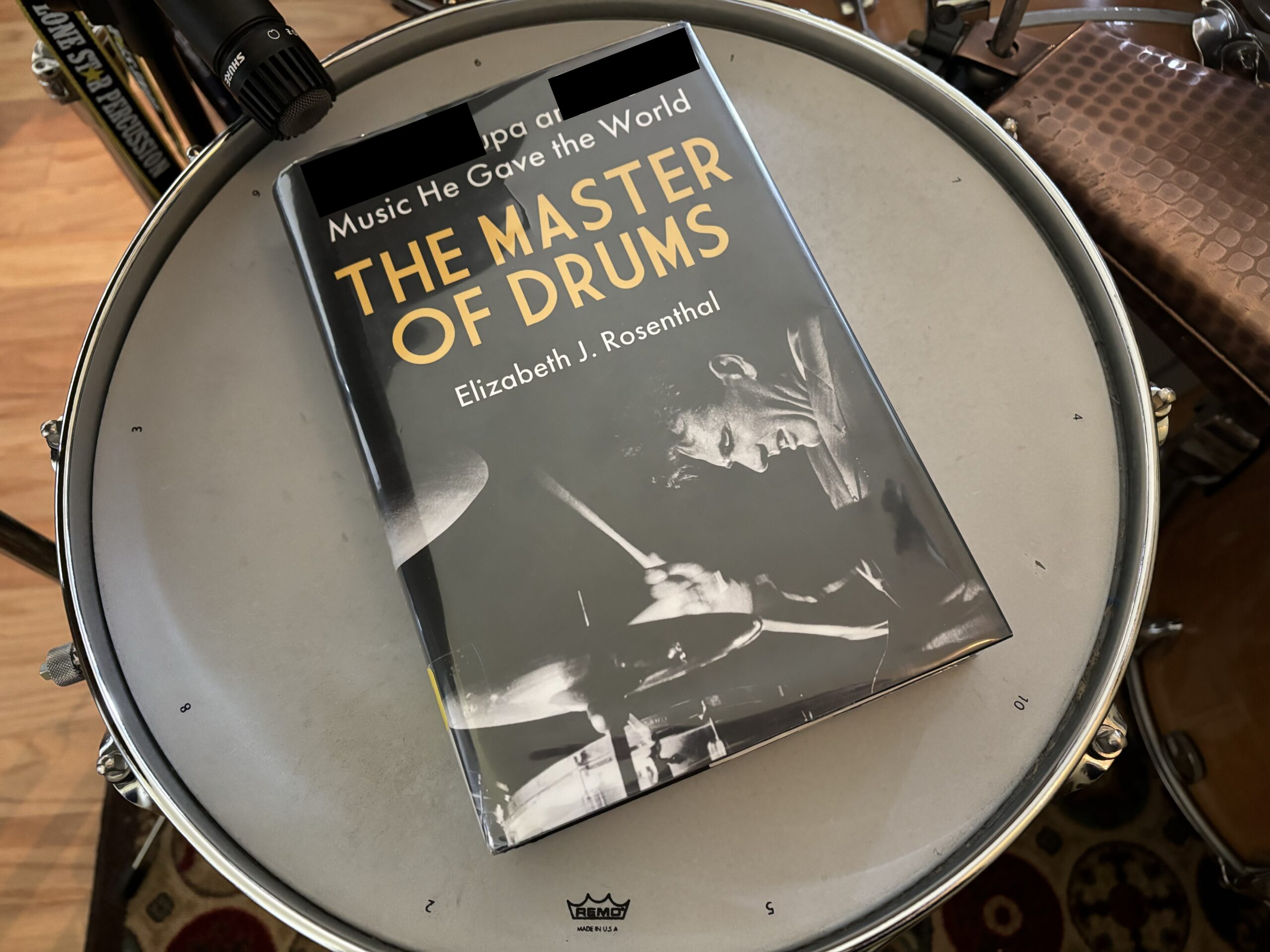
The Master of Drums: Gene Krupa and the Music He Gave The World Elizabeth J. Rosenthal
Had high hopes for this one. The through-line from Gene Krupa to today’s drummers — Jimmy Chamberlain, Stephen Perkins, Travis Barker — still pulses with current, whether through his swing, tribal Afro-Latin flavors or just his style and swag. He busted down the door, brought the drums up front to the mainstream, continuing what New Orleans guys started. Was excited to read a new bio.
Instead, Master of Drums is page after page of names, dates, song titles, venues and quotes, pulled from an exhaustive crawl of internet and archive, and a few personal interviews, lacking much context, nor woven into any real narrative. While the legwork and Googling is impressive, the volume of trivial, monotonous detail is maddening. In one scene, we learn that a band member’s kid thought highly of Mrs. Krupa’s banana bread.
There’s some good stuff: The broad contours of his rise and fallout with Benny Goodman. Vignettes about obsessive practice routines (working out on the pad while chatting with guys on the bus) and broad taste in music. Walking the walk on racial integration in his bands. Insightful anecdotes about his generosity with time and money. Homages from Rock Olympus — Bonzo, Moon, Ward, Palmer, Peart — about how Krupa’s late-50’s bio-pic set the hook.
Hard to get past the whiffs here, though. The author is apparently unaware that the Bo Diddley beat, which she credits Krupa with inventing, is simple 3-2 clave. One page is devoted to appearances of Krupa signature showpiece “Sing, Sing, Sing” in TV and advertising. Wild stretches at metaphor, such as in the run-up to WWII, Krupa’s “hair-raising single-stroke roll in triplets, uncaged as the band joined in for a last, raucous statement, suggested world turmoil to come.”
There’s also a desire to link Krupa to every drummer who ever played a vaguely African tom pattern, and a bizarre fixation on the Spanish word “duende” to describe Krupa’s energy and life force.
Rosenthal deserves credit for the attempt. As Krupa family and associates pass on, it’s no doubt harder to uncover new stories and angles on the legend. But an endless string of quotes, loose tangents and a mind-numbing roll call of names, dates and places gives us only a superficial understanding of the man and artist. An opportunity missed.
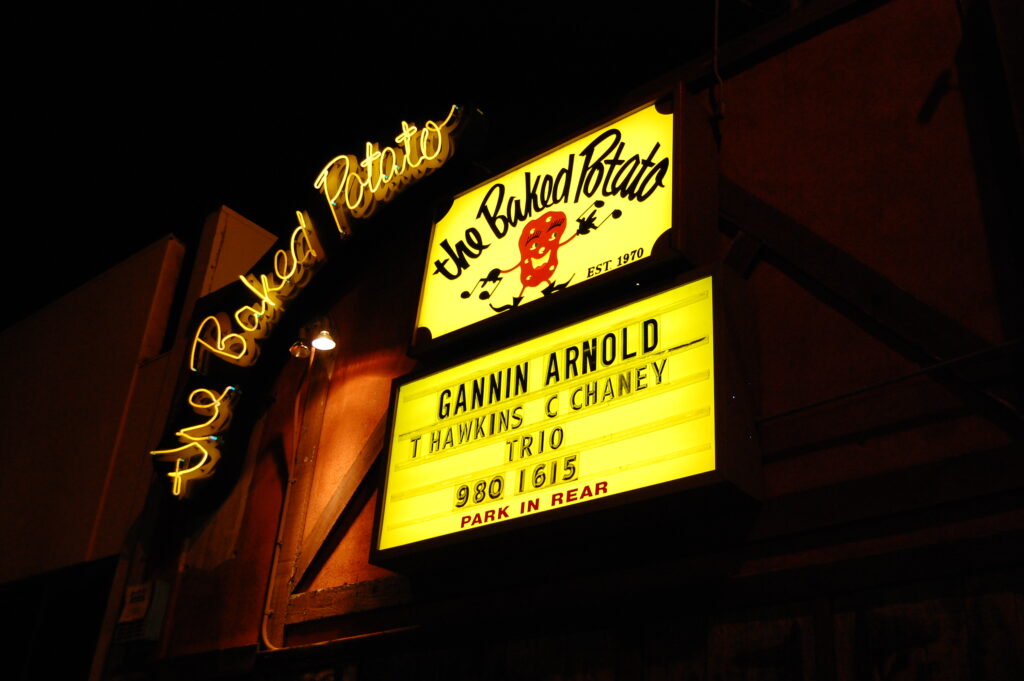
Sometime around March or April of 2010, I went to the Baked Potato in Studio City to catch my cousin Gannin Arnold play a show. Gannin had just released his second solo record, Not From Here, a collection of guitar instrumentals backed by an insane list of guest drummers including Simon Phillips, Jimmy Chamberlain, Stephen Perkins, Gary Novak, Tris Imboden and Pat Mastelotto.
Taylor Hawkins also guested on three tracks, a connection dating from Gannin’s time in The Coattail Riders, the slyly-named side project Hawkins started in downtime from his better-known day job (Gannin played guitar on the first two Coattails records, Taylor Hawkins & The Coattail Riders and Red Light Fever).
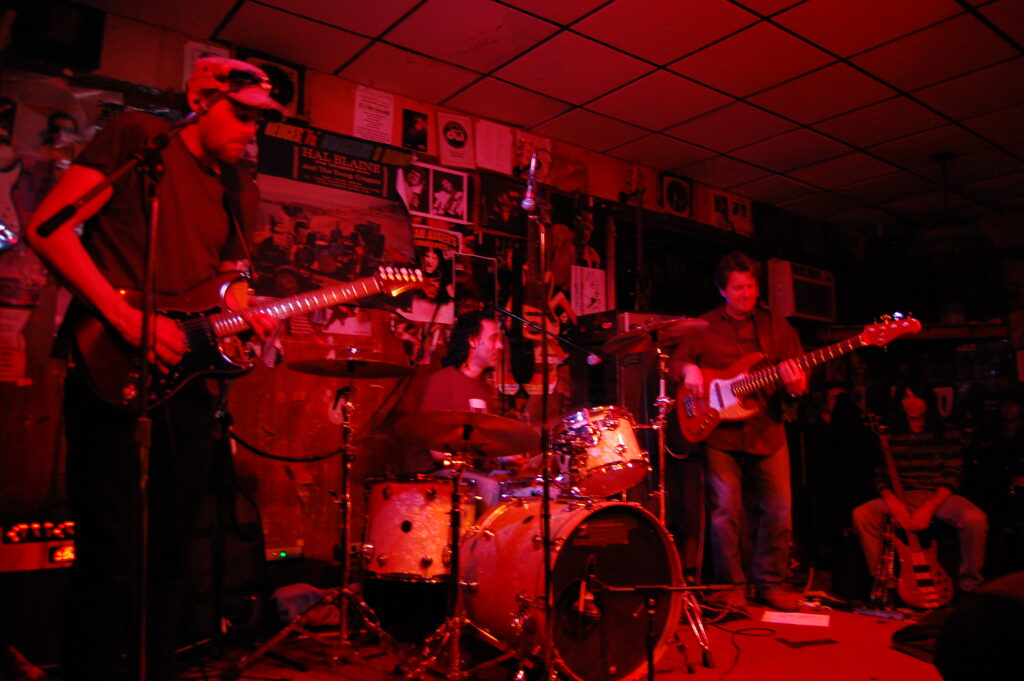
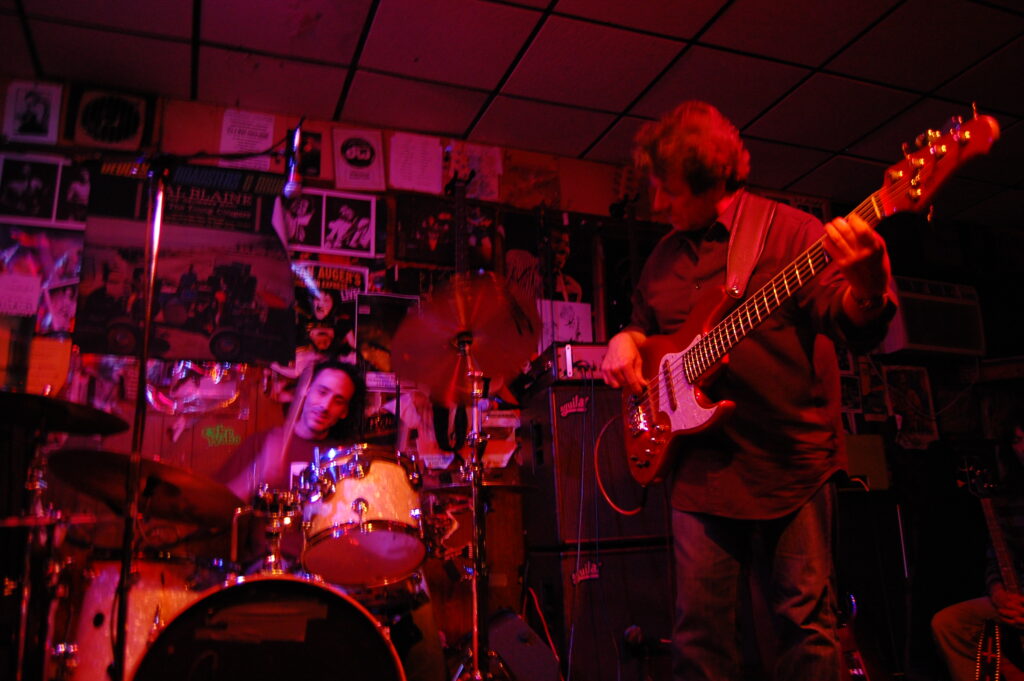
While that drum dream team couldn’t all make it out to Studio City on a weeknight, plenty of heavy hitters turned out to help kick off the new record. Bassists Tim Landers, Rudy Sarzo and fellow Coattail Rider Chris Chaney all sat in, along with drummers Drew Hester, Jonathan Mover and Hawkins, with Gannin leading different combinations through songs from the new record, covers and a grab-bag of collective favorites.
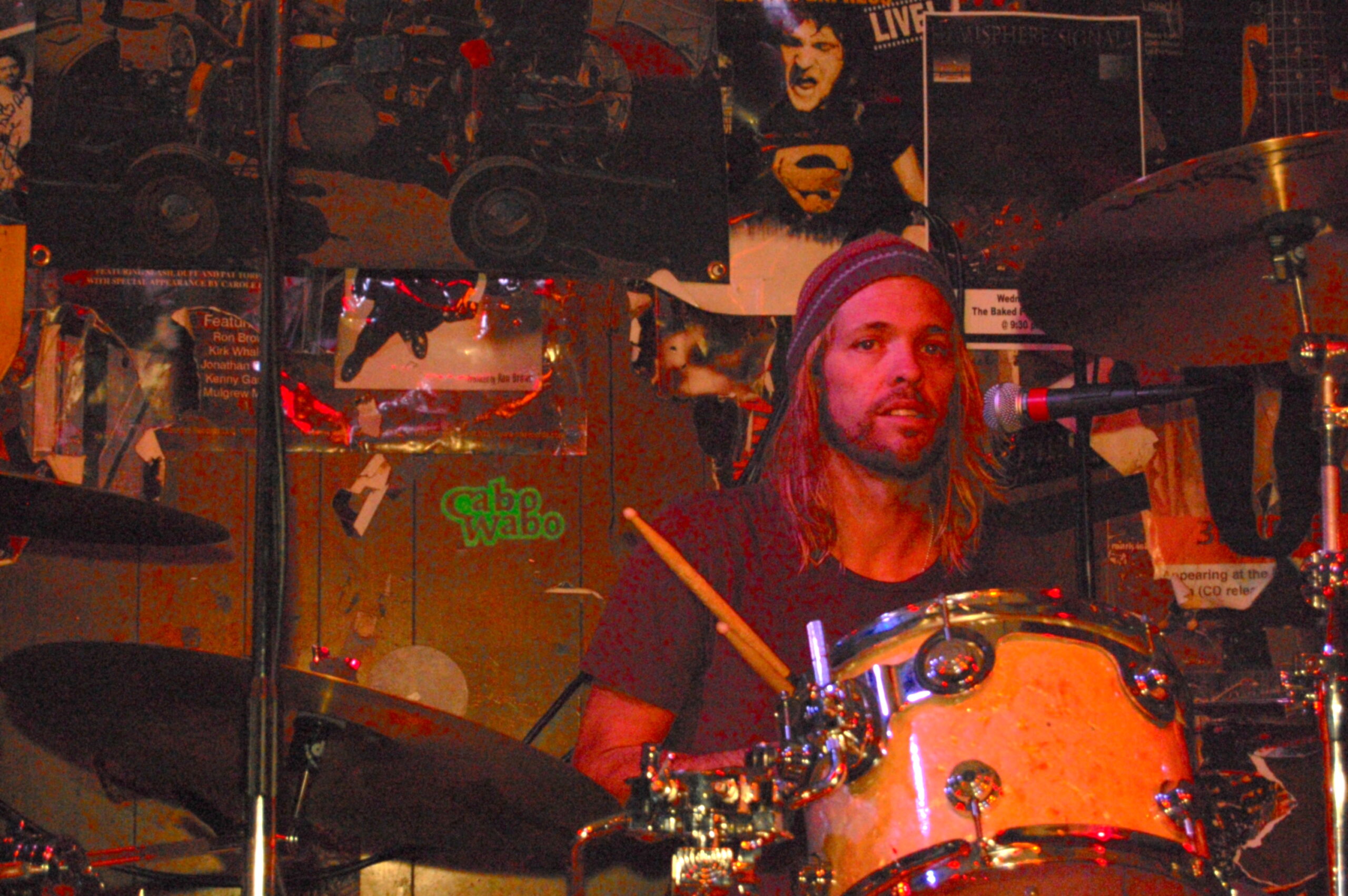
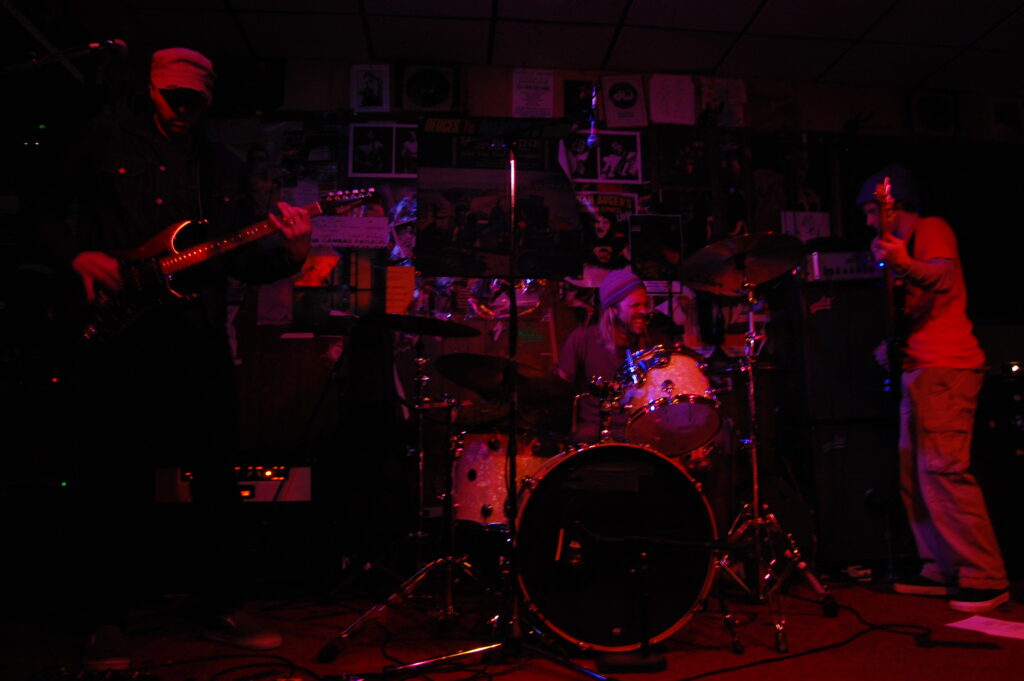
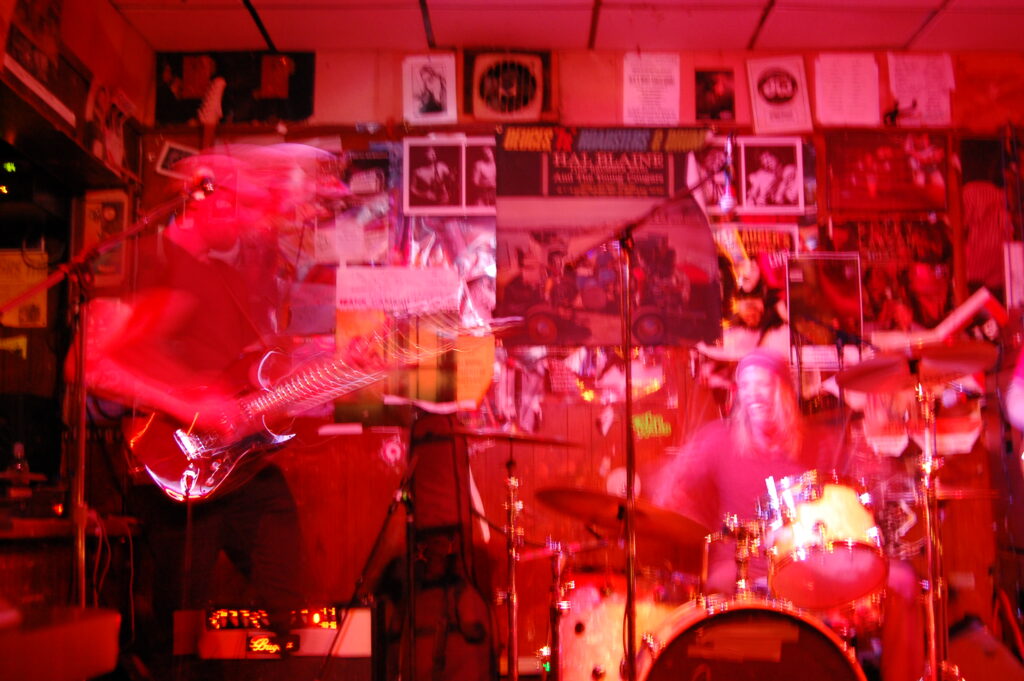
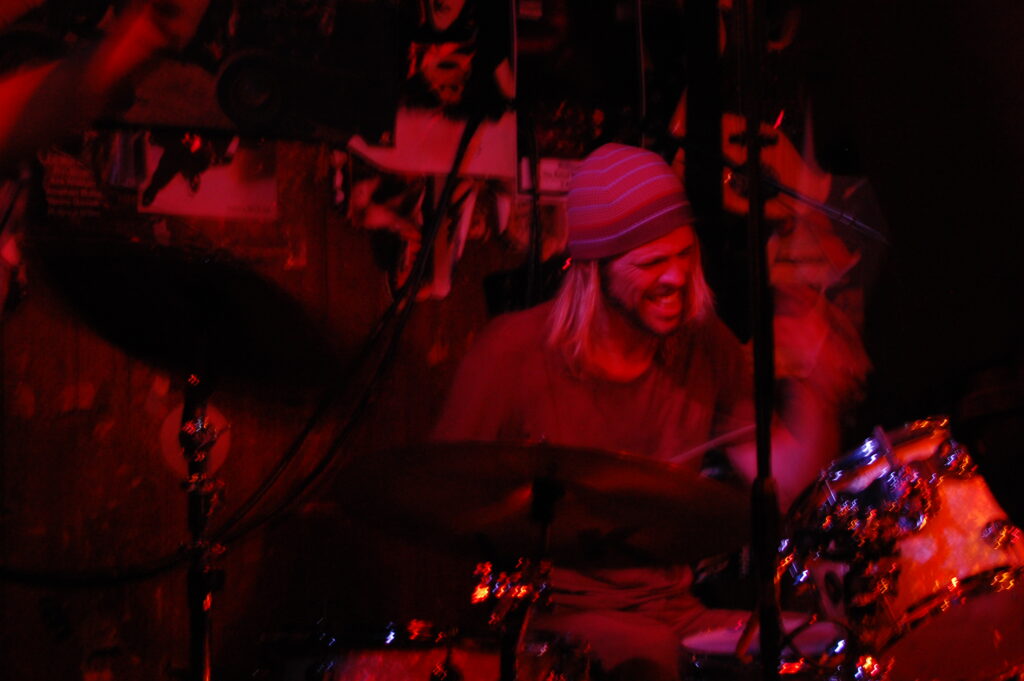
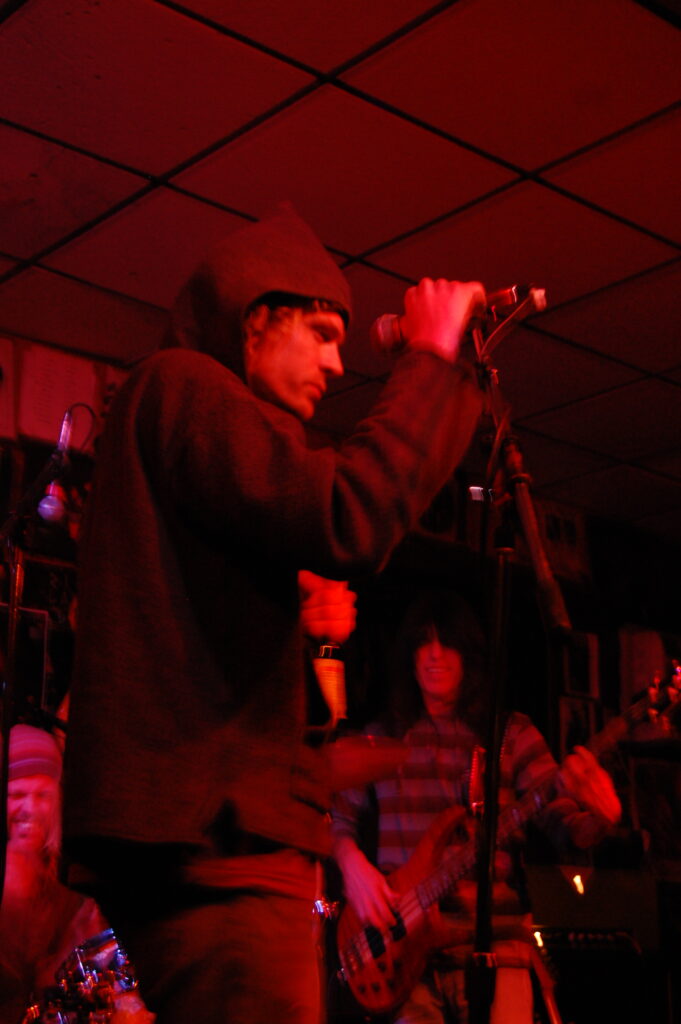
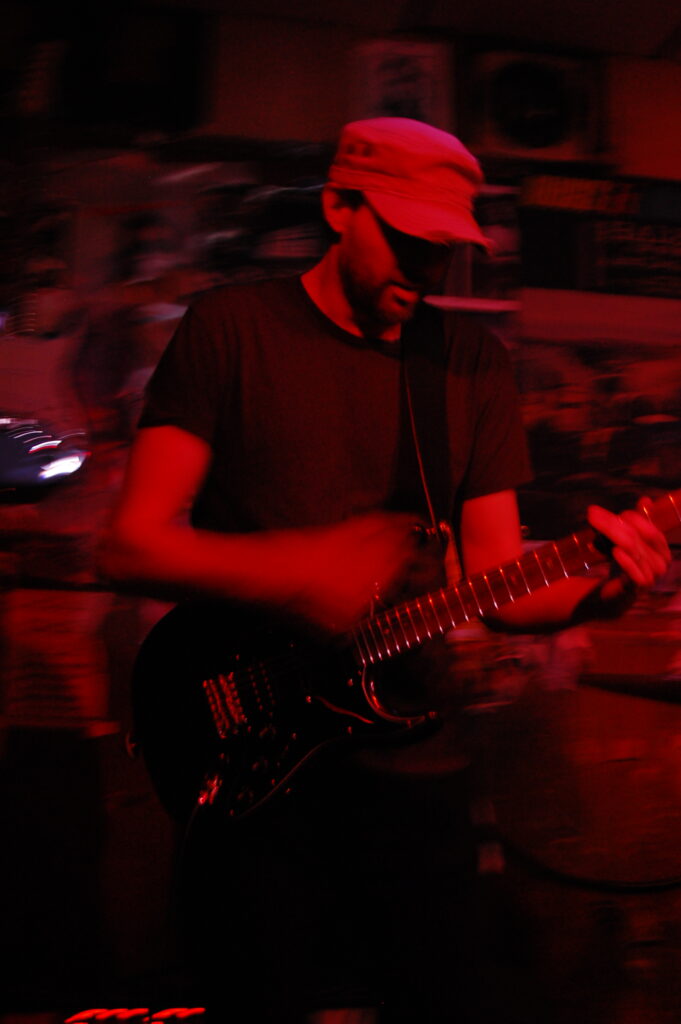
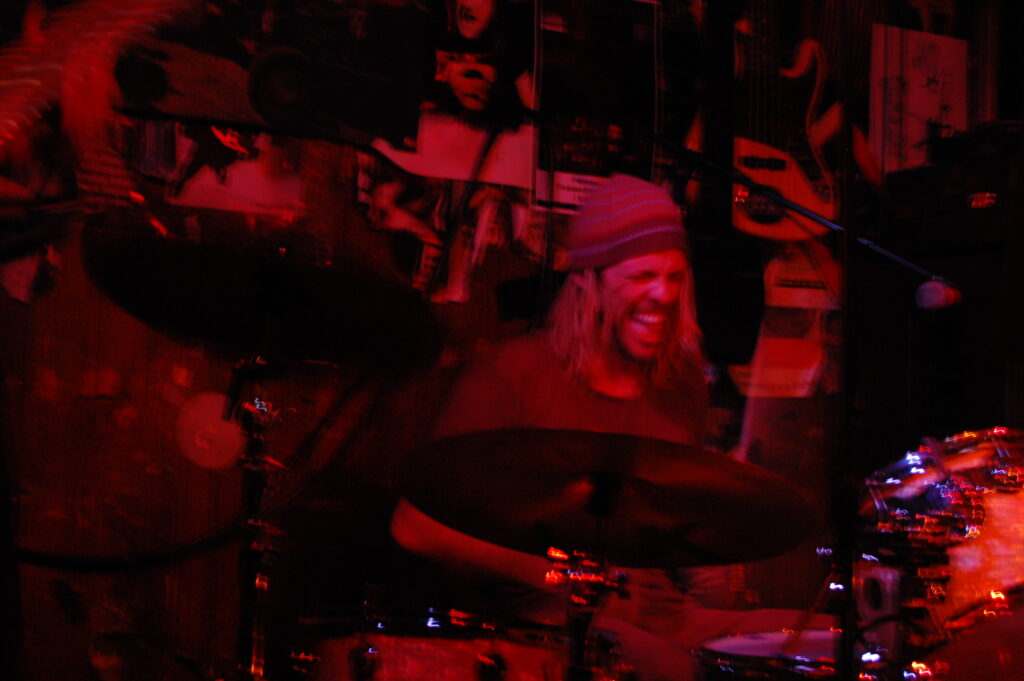
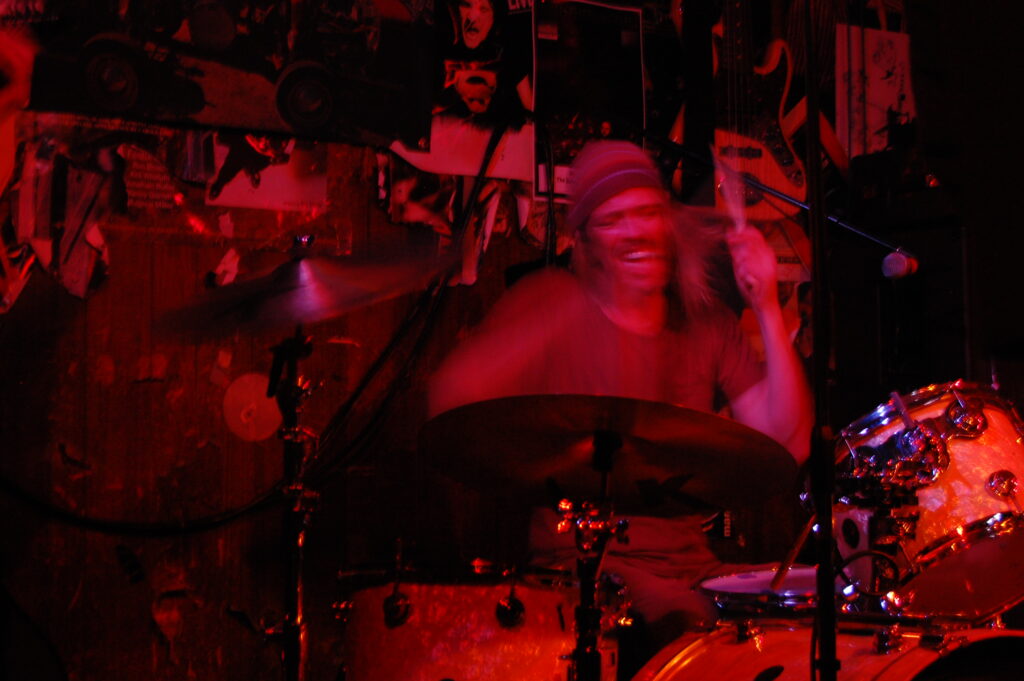
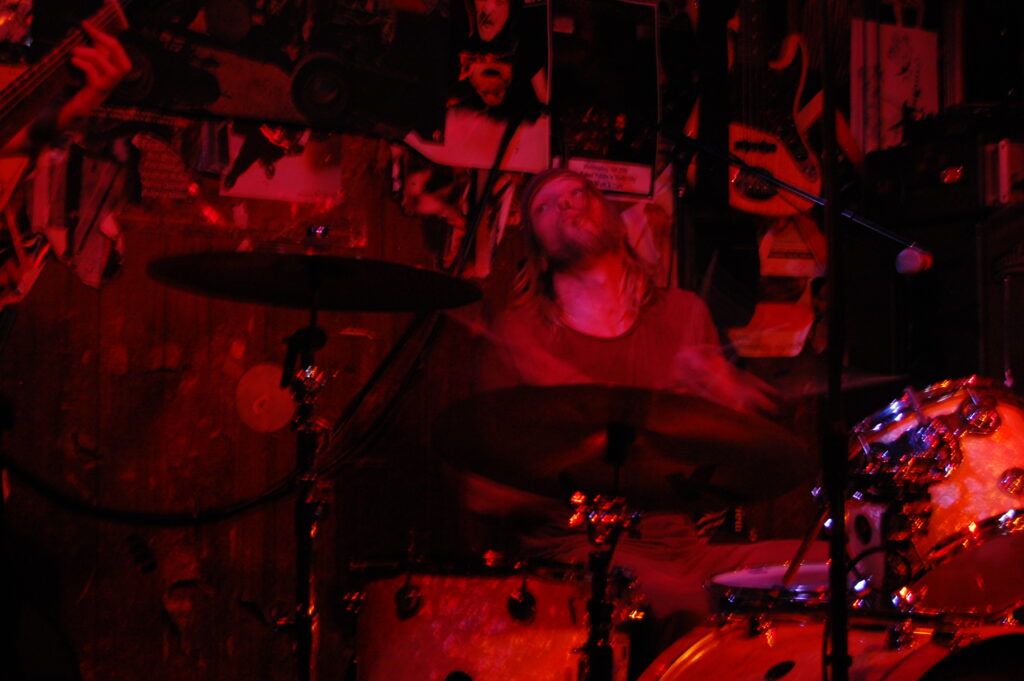
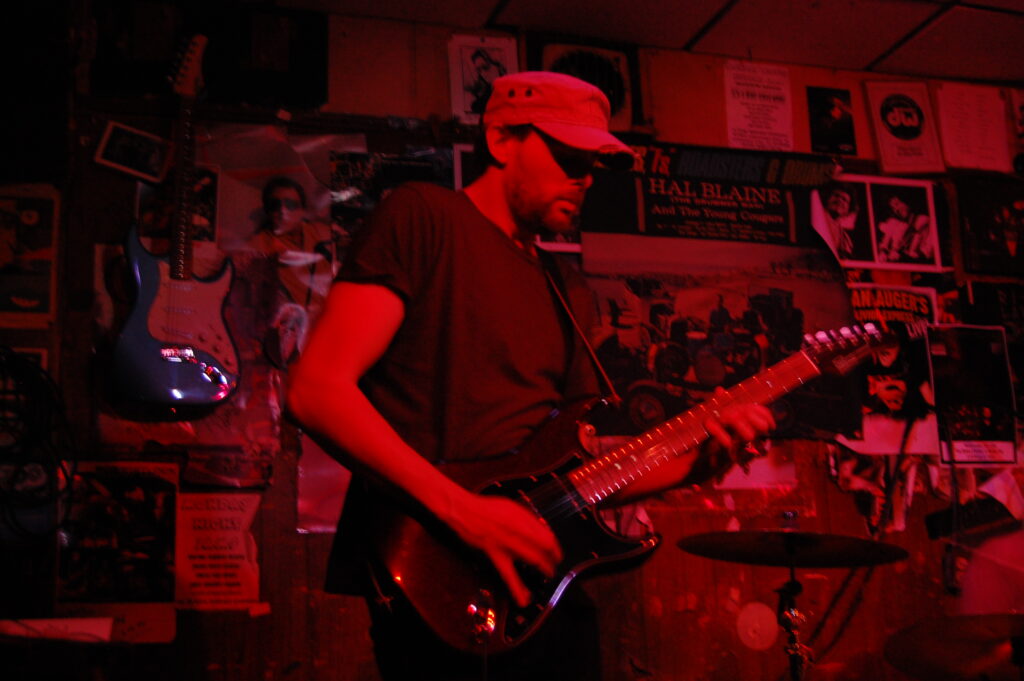
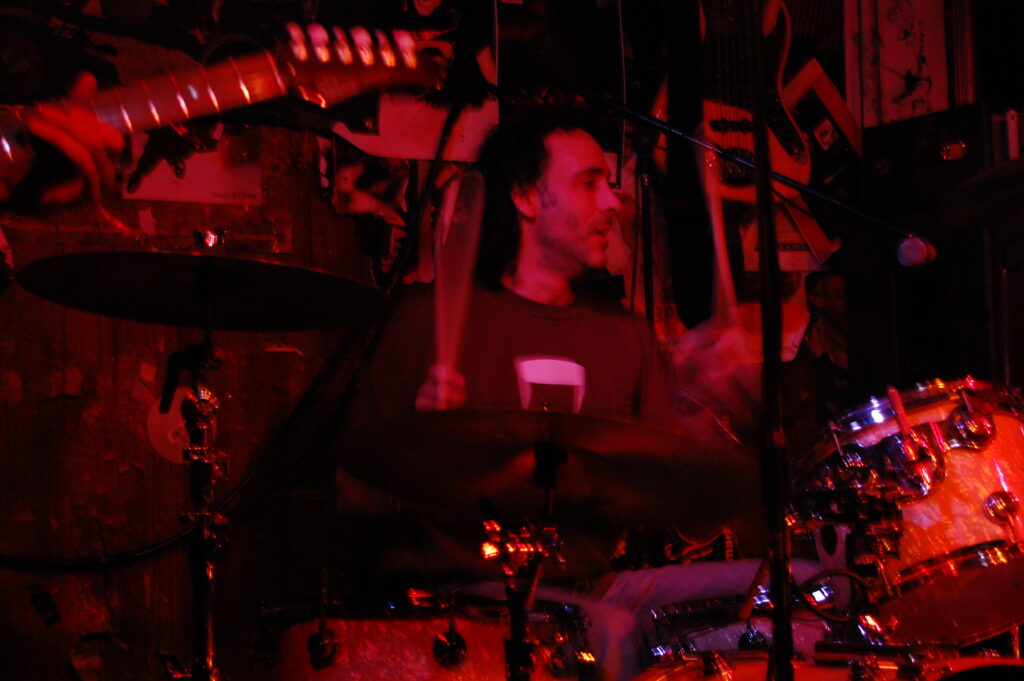
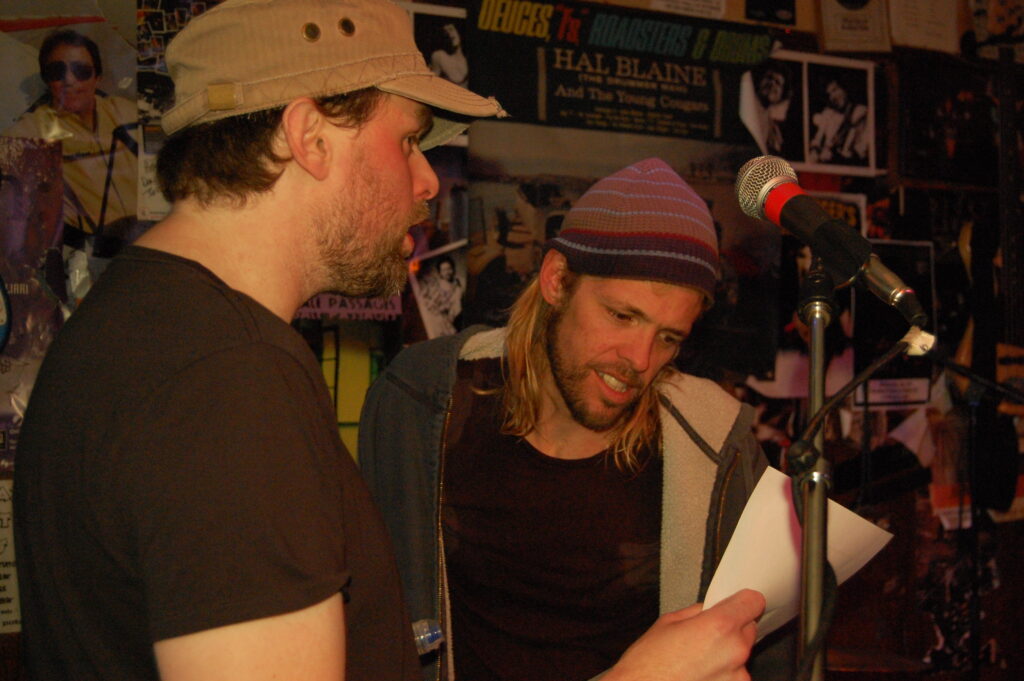
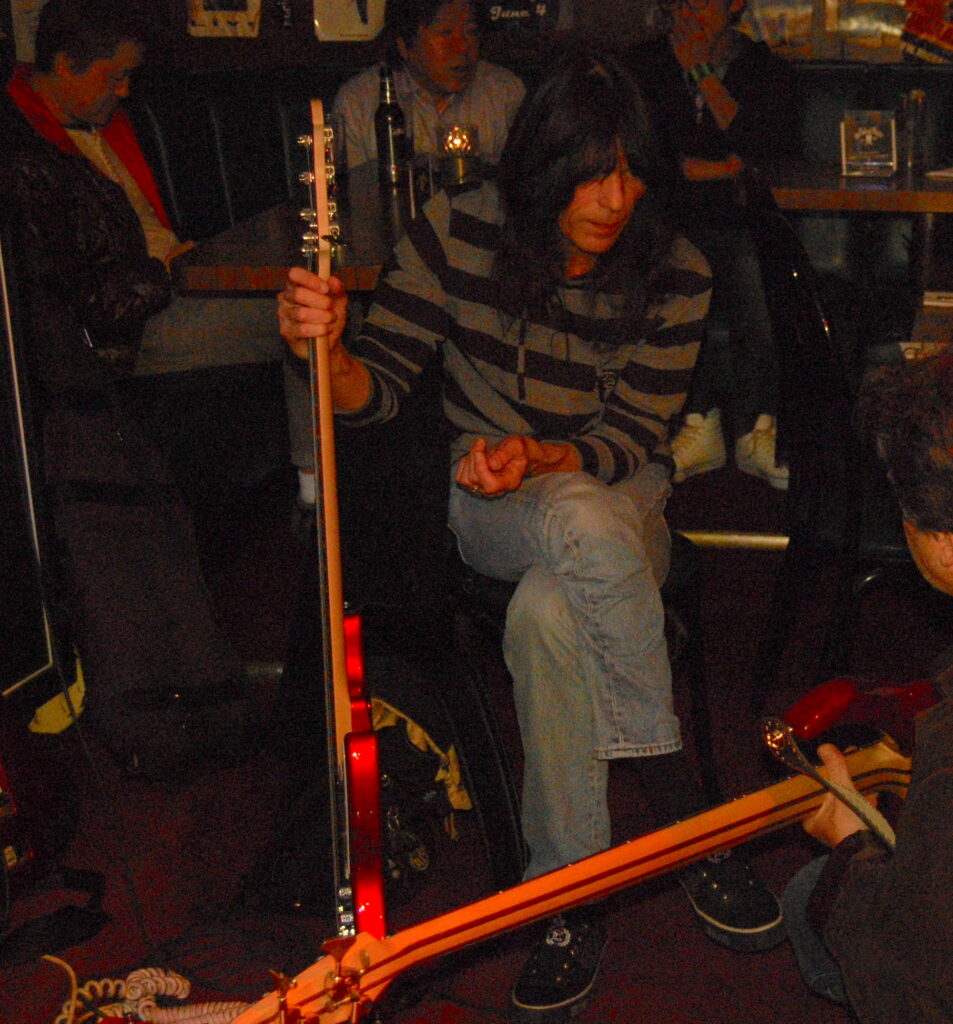
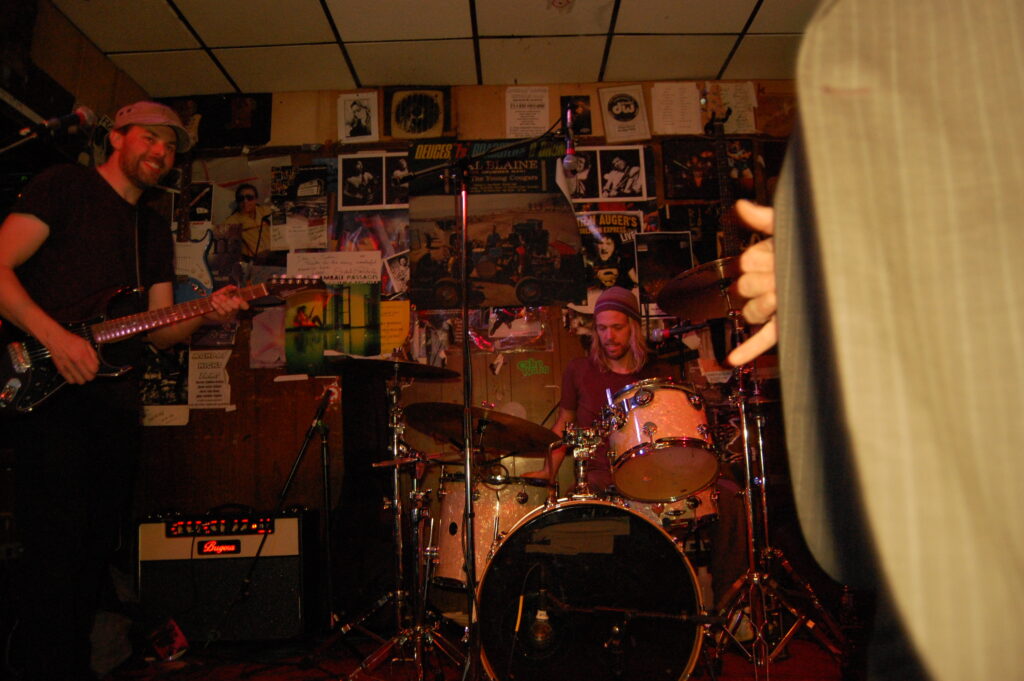
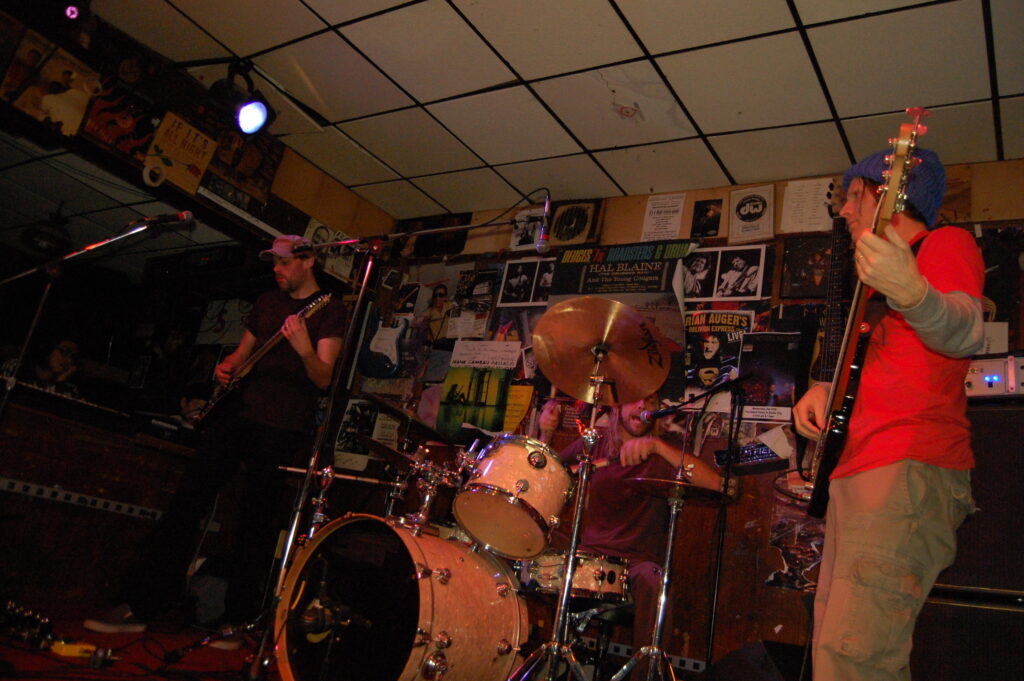
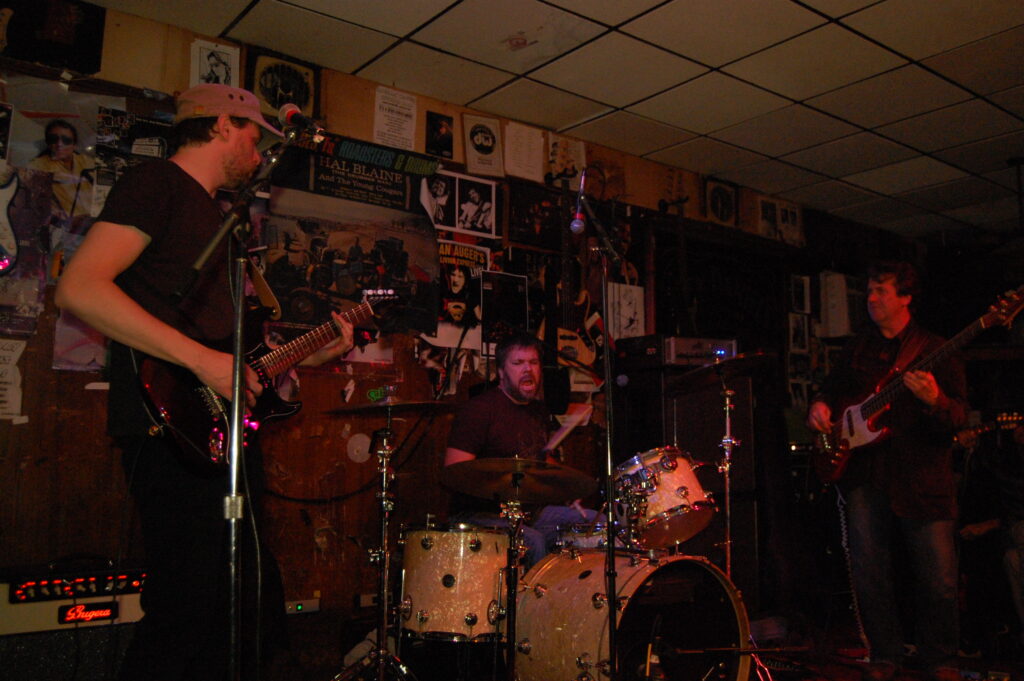
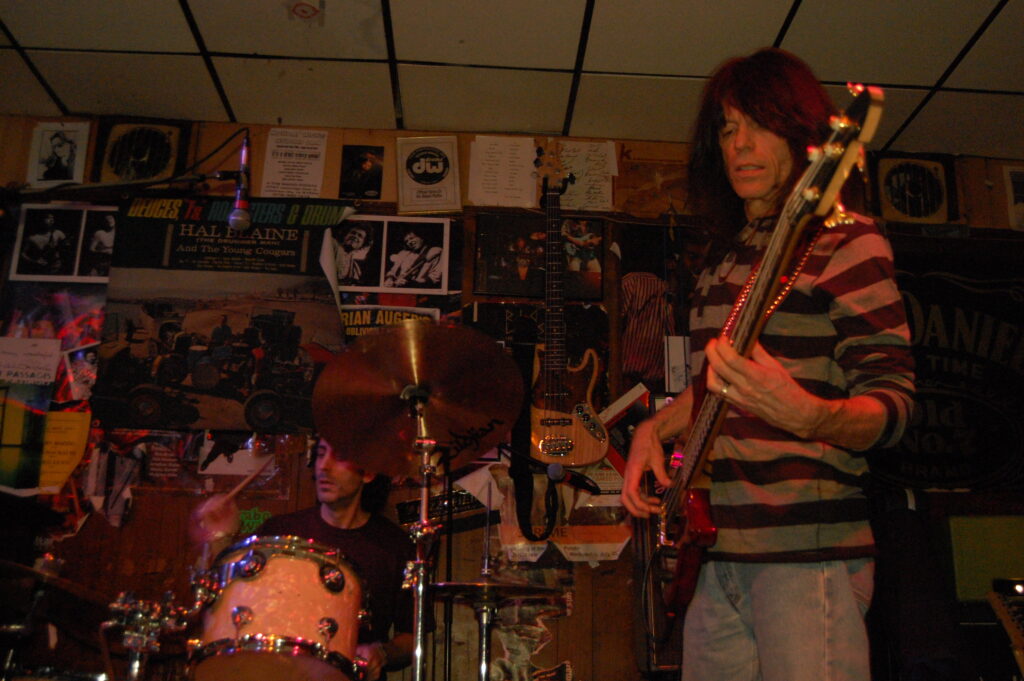
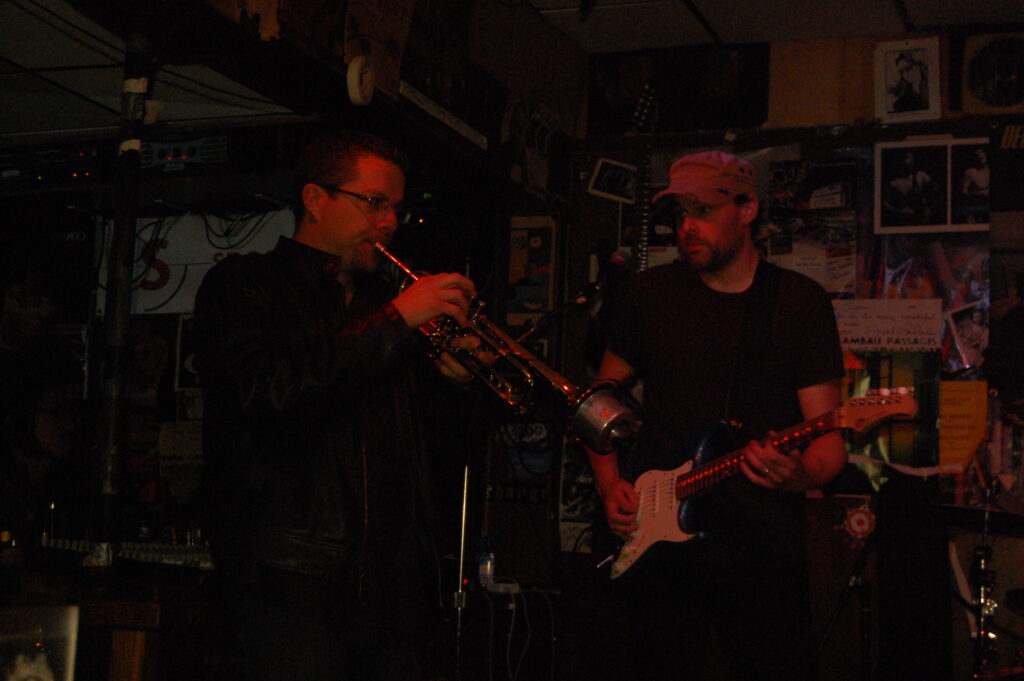
I was lucky enough to catch the proceedings with camera in hand. Being unaccustomed to the new Nikon DSLR I’d borrowed from work, I couldn’t get shutter speeds and apertures dialed in before the gig, and I didn’t want to use flash during the performances. Thus the blurry, darkened images you see here. Wished I’d done better, although the images do have a woozy, ethereal quality that I’ve come to appreciate especially in the wake of Hawkins’ death.
Not From Here is a drummer’s buffet. Probably the only drummers missing from Gannin’s wish list might be Stewart Copeland and Billy Cobham (along with one other legend; see our Q&A with Gannin below). You can see who played on which tracks here at Discogs. Not From Here is at turns fiery, tender, athletic and complex. There are straight-forward rockers, proggy workouts and searching ballads, all reflecting Gannin’s wide range of influences, and perhaps none deeper or more durable than the late master Jeff Beck.
Also check out Gannin Arnold Project: 5 World Class Drummers, a video series produced by Drum Channel where Hawkins, Chamberlin, Phillips, Novak and Terry Bozzio all take a swing at the album’s title track. Here’s Hawkins, Chaney and Arnold — Coattail Riders 1.0 — putting down their version. Ridiculous unison lines all around on the head, with Hawkins’ tight, trademark phrasing and fills.
And now, some photos from that evening…
all photos copyright dan frio 2025
Q&A with Gannin Arnold
What are some highlights you remember from that night? How’d you get all those guys to come out? Playing with Jonathan Mover and Rudy Sarzo was a highlight. I grew up listening to both of those guys on various recordings and it was so cool to share the stage with them.
I seem to recall you saying most of the drummers recorded their parts at their own studios. Most of them did, but there were some exceptions. Jimmy Chamberlain, Taylor Hawkins and Stephen Perkins all recorded their parts at my home studio in Burbank.
You’d played with most or all of those drummers in some contexts before, correct? Everyone except Jonathan Mover. I only spoke to him on the phone, I believe, and we played together for the first time that night.
Had you played with Jimmy Chamberlain before recording Not From Here? Yes, I went on tour with his band, The Jimmy Chamberlain Complex. We opened up for Tears For Fears and did a bunch of shows in Europe. There’s some footage of that band on YouTube. That band was intense! I love Jimmy’s playing. He really has his own thing.
Jeff Beck is obviously a central influence on your playing and the material on Not From Here. I’d say I also hear some Steve Vai in there. That album was really was about all my classic rock influences. Ritchie Blackmore, Joe Walsh, etc. I was really trying to capture that spirit in a fusion context.
Do you have any lasting favorites from that album? Any tracks that stick with you more than others? I like “Blue Ships” a lot harmonically. The title track has also really endured the test of time. That’s a fun one to play and Jimmy sounds great on that track.
Were you still playing with Coattail Riders at the time you finished and released Not From Here? Yes, we had recorded the first record and toured together.
How did you first meet Taylor? Through my friend Drew Hester who was playing drums with Joe Walsh at the time. They were childhood friends growing up in Laguna Beach.
What were your first impressions of him? Super high energy. Very intelligent and knew his rock history. We had a lot of the same influences, especially Rush and Queen. We became friends pretty quickly.
Did you guys bond over any Orange County-isms? Not really, interestingly enough. I mean we understood the culture for sure, but we didn’t talk about it very much.
How well did you know his playing before you started playing together? Had you listened to much Foo Fighters before? I knew those early Foo Fighters records and I saw him play with Alanis Morissette. I loved his high-energy style of playing.
Can you describe his playing in a few words? Powerful, intelligent and raw.
Playing alongside him, could you hear his singing/songwriting ability come through on the drums? Yes, he had a compositional way of playing. You could definitely tell he approached the drums in a musical way, and not just as a drummer who likes to hit things!
If you could have fit more drummers on Not From Here, who else would you have asked? Bill Bruford. I actually reached out to him, but he declined because he was retired at the time.
When’s the follow up? No follow up yet. I would like to make a jazz record with some of my favorite jazz drummers. I would have loved to play with Jack DeJohnette. I was so sad to hear he passed away. What an amazing musician he was!
Shawn Lee is a songwriter, producer and multi-instrumentalist from Wichita, Kansas. Since the mid-1990s, he’s lived in London after signing a record deal with global music ambassador Gilles Peterson. To date, he’s released a few dozen collections of beats, breaks, full albums and collaborations spanning an eclectic range of genres.
There are groove-heavy, percussive instrumentals that reflect his love of library music (music made for ads, TV, video games and other visual mediums, today known as production music); dips into 80s synth fun as alter ego David Fostex; modern takes on classic soul; collaborations with Chinese zither specialist Bei Bei; and most recently durable success with co-songwriter Andy Platts in smooth-rock project Young Gun Silver Fox (‘yeah, you could call it yacht rock,’ Lee says).
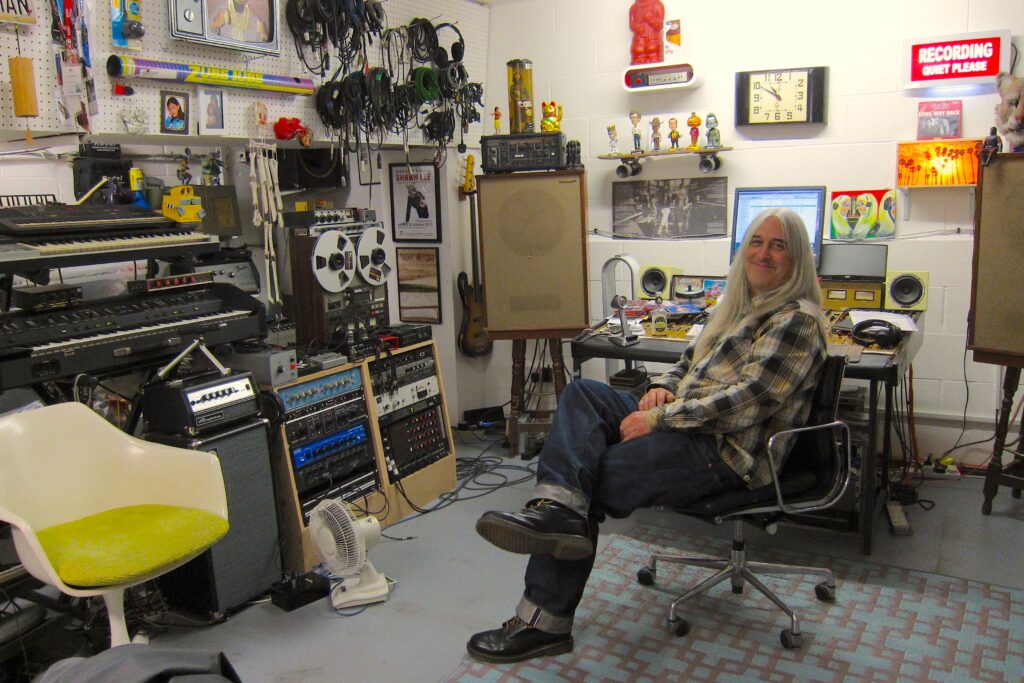
When not recording his own material, producing others, or collaborating, Lee can often be found out on short tours as a sideman, playing guitar, bass or drums. Or he might be putting together documentaries, such as the Library Music Film or a forthcoming book of photos and interviews from the studios of friends and musicians. He’s definitely collecting vinyl and CDs from the road, and adopting all manner of stray instruments from eBay to fill his whimsical London studio. Yet even with his prodigious output, Lee considers himself a drummer first and brings a drummer’s sensibility to all of his work. Lee and I spoke in London over the course of two interviews in 2017 and 2018.
DRUMMER FIRST Syncopate Mag: You play guitar, bass, keys, drums. You also produce other artists. But you consider yourself a drummer first.
Shawn Lee: Yeah. I actually started on guitar, then drums about a year later. And I played a lot of drums for awhile. Then when I started to write and record songs, I moved back to guitar. I think there’s a stigma with drums and drummers. As if you’re less musical. You’re the guy that hangs out with musicians.
SYNC: The old joke.
SL: Yeah. But it’s sorta real. It’s hard to come out from behind the kit and be taken seriously. I’ve worked really hard to shed that. I became like an undercover drummer. When I started writing and recording, I realized that getting a drum track wasn’t about blowing people away with amazing chops. I just want to play a nice beat.
SYNC: I’ve seen you a couple of times when you’ve toured America. You were playing bass one time and guitar another. But I often see photos on your Instagram where you’re behind the kit on some European tour on in the studio.
SL: I’m still a bit of a drum monkey. Still doing it. I think I’m actually drumming more now than I have in maybe 30 years. The last six months, I’ve probably done a drum session for someone every month. I’ve played on a whole album as well. Playing for people I don’t know, getting called for sessions from links in the network.
SYNC: But you’re primarily known as a one-man band, solo recording artist. Why do you think you’re getting calls to play kit on sessions?
SL: I don’t know. I think people see something slightly different in me. Someone that gets a good sound, has a good feel, plays songs and can play in the studio. Playing drums in the studio is a very different thing than playing live. The way you hit, the tones, what you don’t play. Some drummers tend to play really hard live. Then they get in the studio and hit too hard. Under a microphone, they can’t change their dynamic because that’s just how they play. If I’m producing a band and they have a drummer who’s playing really hard, I’ll sometimes ask, ‘Can you hit the snare softer, the hi-hat softer?’ They can’t do it. They try it for a second, then revert back.
SYNC: In the studio, are you focused on how you’re hitting the drum, where you’re striking it…
SL: Totally, yeah. It’s all about tone. It’s very much about the drums that you use, the cymbals you use, how you hit ‘em. Doing more with less is what playing drums in the studio’s all about. My worst nightmare is overplaying. It really is. The more I play, the more I feel ideas bubbling up that want to come out. But you kinda have to hold it at bay a bit. I’m not gonna let my hands just do whatever they want. I want to hold it back.
BAND GUY SYNC: It seems like you’ve worked on your own most of your career. Have you ever been a ‘band’ guy?
SL: Well, I guess I sorta haven’t been. I’ve always been like a lone wolf. I’ll play in other people’s things, I’ll work with other people. When I moved to L.A., before London, I moved there to to do my own thing. Invariably I ended up playing in bands. I love music, I like to play music, I like to be around talented people, I like to be busy and do different things. So if someone was like ‘Hey man, do you wanna play drums on this recording? I got these gigs, do you wanna play cowbell?’
If it interested me, I’d do it. If something comes along, the people are cool, the music’s cool, I’d just do it. I wasn’t worried about how it looks. I was always a jack-of-all-trades. But back then, people were like “Oh, you gotta do one thing and master that.”
SYNC: Specialize.
SL: Specialize, yeah. ‘That’s the only way you’re ever gonna make it.’ I disagree. And that doesn’t interest me. Every situation, you learn something which you bring back into what you do. You’re constantly gathering experience, information, redefining and exploring. You don’t get stuck in your little narrow box.
SYNC: What about touring? I know you tour some these days, but did you make a specific decision at some point not to be a touring guy?
SL: I kinda did, yeah. I love the studio. If I was touring, I’d be wanting to do my own shit. Because if you’re out touring with other people, playing with other people, you’re spending a lot of time and energy with somebody else, and you don’t spend a lot of time playing music. So you have to decide if it’s really worth it.
I liked playing with people, but I preferred doing sessions. Because there’s a beginning and an end. Also sometimes people just wouldn’t ask me to do live stuff because they didn’t think I’d want to do it. Or they’d think I was too busy. I reckon I’ve lost out on some things over the years from people assuming that, thinking I’m too busy doing my own thing and wondering why I might want to play, like, triangle in someone’s band.
But most of the time, if I have time to do it, if there’s cool people involved, if I like the music, then yeah, sure, I’d love to go play in Barcelona. I’d love to do this little German tour. If there’s a beginning and an end, it’s kinda like why not?
SYNC: But would you want to be away from home for, like, six months now?
SL: Oh, hell no. Even when I’m doing my own thing, the longest I’m ever gone is maybe a month. Most of the time I’m only gone for like 10, 12 days at the longest. Usually it’s only like two, three, four days. Short and sweet. Maybe a week if I go to America or whatever.
LIMITATIONS, PLATEAUS & ORIGINALITY SYNC: You play most of the classic rock & roll instruments — drums, guitar, bass, keys — clearly well enough to make interesting solo records and lead projects. Do you feel like you’ve plateaued on any of the instruments?
SL: I’ve plateaued on everything. A lot of times it’s more about refining rather than increasing the vocabulary. It’s about doing the things you do more efficiently. If I was just playing guitar, I still wouldn’t be putting guitar players out of work. I’m good, but what I do is more nuanced and subtle, simple and to the point. I work with musicians all the time and sometimes think ‘Everybody’s better than I am. I can’t play half the shit they can play.’ But then I also realize that none of them could do what I do.
SYNC: If you’re hanging around better musicians, you’re hanging around the right musicians, right?
SL: Exactly. They up your game. That’s who you want to play with. I always want to play with people better than I am. They make you better, keep you on your toes. You don’t necessarily want to be the best musician. You want to think, like, ‘Yeah, OK, I’ve worked with some incredible people and they respect me. I must be doing something right.’
I think what a lot of musicians do, ones that are really, primarily, into one instrument, they keep playing and accumulating vocabulary. Then they can play anything and they tend to get more and more technical. But now because they can do anything, they often end up doing nothing. There’s no strong direction or focus. They just get more and more technical, but were better when they could play half as good. There was more enthusiasm for what they did. It wasn’t about being fancy. Sometimes feeling like you were slightly limited, you worked harder within your capabilities.
SYNC: Working within your limitations.
SL: Right, working with limitations. I think for me, playing a lot of instruments, it makes that easy. I pick one up, get better at that. Then I can come back to another thing and maybe that makes you better on the other thing. You bring something back. It keeps it fresh and interesting. In a way, I don’t plateau. I’m constantly doing different things.
But I’m not trying to learn more licks on guitar, for example. I’m playing the same licks I’ve always played. But it’s about playing them in the right place, at the right time, with the right feel and the right sound. It’s the economics of making every note count. Do more with less. That’s the evolution of the game. Like BB King.
SYNC: Oh, man. Talk about a guy with one move. In a great way.
SL: Yeah! One move. But it was the best move. And he executed it with so much feeling, so much style, every time. It was so authentic, so him. I think sometimes people get hung up on originality. I think it’s just about doing stuff really good, doing your thing and doing it really good. Being the best at what you do and the way that you do it. That’s what it’s about. It’s not about ‘Has anybody ever done this before?’
SYNC: I think it’s cool when bands and artists reach for something they haven’t heard yet, though. Or combine a few things in fresh ways. I always go back to Jane’s Addiction. At that point in my life, mid high-school, they just sounded so different and original. But you listen close and could pick out the references: Bauhaus, the 80’s goth, Zeppelin, funk and shred-metal. All those guys had unique, individual approaches that made it sound fresh and vigorous.
SL: Yeah, you could hear the influences. But I remember hearing them and thinking they were quite unique. And Perry was quite like, whoa, you know…
SYNC: Yeah. And Perkins. Stephen Perkins already had his own thing at that point. Young guy, but already a signature sound.
SL: Oh yeah, Perkins. Fantastic. I have a Perkins story. I was living in L.A. and I used to see him around. I was somewhere, playing somebody else’s kit. I don’t even remember who I was playing with, but Perkins was there. Might have even been his kit, I don’t remember. But I remember I played this fill I’d never played before and I never played again. I don’t know what it was, but it was like a magic moment. And it was just like, maybe because you’re playing somebody else’s kit, your hands just go some place. Like you made some lucky shot, some impossible thing. Those things are sad because you know it’s a one-time thing, you can never get it back.
And Steve Perkins came up to me after the set and he was like ‘Man, you did this one really amazing fill.’ I said, “I know! What was it? Do you remember what I did?” (laughs). It’s one of the handful I’ve ever done, my greatest hit.
SYNC: That’s awesome. Props from Perkins.
SL: Yeah, he’s good. A friend of mine played in this jam band with Perkins and Mike Watt.
SYNC: Banyan?
SL: I don’t remember. What were they called? It was Eric Garcia, Mike Watt, Stephen Perkins, my buddy Josh. I remember taking Gilles Peterson to see them play in Hollywood. He was like ‘What the fuck is this?’ Then they started doing Porno For Pyros. My friend Josh was in the first lineup, playing winds, bass clarinet, saxophone. Multi-instrumentalist guy, could pick up anything, figure out a part. Yeah, I saw Perkins play a lot. He was always really good. Cool, cool style. I wasn’t even really into that kind of music, but you could hear there was something really cool in Jane’s Addiction.
SYNC: He had a voice. Still does.
SL: Yeah. Early 90s was a cool time in Los Angeles. Fishbone, Jane’s Addiction, Eleven.
SYNC: Jack Irons, yeah.
SL: Yep, Jack Irons. I used to see them around a lot. It was a cool scene.
ON WORKING FAST AND KEEPING FLOW SYNC: Given your prolific output, I assume you work pretty fast.
SL: I work really fast.
SYNC: Do you keep track sheets and stuff? Like, ‘OK, I did the drums, now…’
SL: Never. The only time I write anything down is if I’m away for a bit and I’ve got a bunch to do. I might write a quick hit list so I can come in and be like ‘Checked it off. Yeah, turn that down, more reverb on that.’
I like to come into the beginning of a session and get as much done as possible. So that I’m feeling good, I’ve got some momentum. I’ve sorted that out, I’ve bounced that, I sent somebody that, I’ve compiled some stuff for the radio show. It’s this constant kind of conveyor belt of getting something to the next stage. Finishing something, sending something off, dialing in something that you just started. It keeps it fresh because you’re doing lots of different things and you don’t get that fatigued thing where you’re like, ‘Uh, I don’t know what to do next. I’ve hit a wall.’
If I do feel like that, I’ll just move on to something else. It’s like excavating layers of things. Once you’ve got the basic track of something, you can think about the next layer, the next overdubs. I don’t wanna just throw loads of stuff on there and then sort it out later.
SYNC: What’s your routine?
SL: My routine depends on my workload. But my normal thing, if I’m not working to a deadline, is just come in at 11:00, work until about 7:00. Have lunch. Very civilized. I work really fast, really focused. It gives me a good balance on my time, for family time and sorting out other shit. Chasing things, all the admin work. That’s a part-time job and then some.
If I’m working to a deadline, depending on (engineer) Pierre’s availability, I’m here three, four days a week. And that’s kind of about it, really. And then I’m doing other stuff.
SYNC: When Pierre comes in, he’s behind the board and you’re playing?
SL: Yeah, exactly. Things are pretty wired in.
SYNC: Do you make commitments as you go?
SL: Totally. That’s the name of the game. It’s also about trusting that your first thought is the best thought. It’s about believing in the idea, not being wishy-washy. But I’m also quick to give up on something if I know it’s not happening, I won’t try to square peg it into a round hole. That just comes from years of experience and being decisive.
SYNC: You’re really prolific, though. You must throw a bunch of stuff at the wall, yeah?
SL: I do. But in a way that’s part of it. There’s no real pressure, other than the pressure I put on myself to do it better and get better at what I’m doing. I just trust in the process of what I’m doing. For me, there’s no failure in making a tune. The process itself is the reward. What happens in the end is sort of up to the gods, and sometimes it’s for other people to decide what it means. For me, the best thing is when you make a tune and it feels like that you didn’t even make it. You feel like the tune always existed, but you just found it.
SYNC: Those don’t come very often, do they?
SL: They don’t. But the thing is they come because you do lots of shit. They come because you’re always doing the work, creating an environment where magic can happen. When you’re doing stuff all the time, it keeps you loose and that’s where the good stuff happens, when you relax. A lot of people think ‘Oh, this record has to be the ultimate. This song has to be as good as…’
SYNC: You’re not going to hit a home run every time.
SL: No, you can’t. Once you decide not to do that, I think that’s when you do something really good. You do something, trust your instincts, get it done, and move on to the next thing.
SUCCESS AND WHAT IT MEANS SL: For me, there’s creative and artistic success. But then there’s the success of being able to survive and keep doing what you love to do. I think the lack of other kinds of success sort of indirectly fuels my hunger to always do something better. I’m not worried about being relevant, I’m not worried about being cool. I’m not worried about selling records. As long as I can put food on the table, pay the rent and keep doing what I love to do, then that’s it. That’s the name of the game.
SYNC: That’s the dream.
SL: That’s the dream. I’ve seen many people have bigger splashes in recognition, get nominated for a Grammy, have a hit and get love from the press. They get on big TV shows, they’re hip, on big stages at festivals. Most of them have their 15 [minutes], then it’s like a slow fade to gray. I’ve never ‘made it.’ I’m still trying. I’m still ‘making’ it.
We’ve made a film, we’ve put love into it, into making something good. That’s how I view anything anyway. You do it because you wanna do it. And whatever happens, happens. And you share it with the rest of the world and the people who dig it, dig it. And it all adds up to more good shit in the world. It’s one of the only things I can do, and maybe the best use of my energy. It’s the way I can put something cool into this world, other than taking care of my family.
SYNC: I think you’re an inspiration, man. You’re doing it, making music. Doing something that you love and making a living at it.
SL: Thank you. Well, what’s life about? I can’t think of anything worse than doing shit you don’t wanna do. Being pissed off about it and frustrated. That’s just a waste of life. Because we’re all struggling to survive on every level. Mentally, emotionally, financially. Nothing’s easy. It’s a struggle and sometimes you’re doing good and sometimes you aren’t.
SYNC: I think we’re cursed at birth. I think everybody’s creative, but some of us are cursed with a need to share it, whether the world asks for it or not. And so you have to follow that. We can’t sell insurance, you know?
SL: Totally. There’s nothing else that I can do. There’s nothing else I’m good at. I got nothing else to give.
SYNC: Some cats can sell insurance, make a nice salary, take care of their family. To them, that’s enough.
SL: Yeah. And then they can do something as a hobby, for a laugh. That’s enough. That’s pretty cool, actually.
SYNC: Yeah. Photography or whatever.
SL: Yeah. I envy people like that, somebody that’s got a really good gig, where they do good and don’t seem to hate it. They kind of enjoy it and it gives them the freedom to be able to do this and do that. That’s kinda winning. You can do that and you don’t have to make any money from it. Just do what you want to do. There’s a beauty in that. But for me, I’m all in. There’s no other way. I think the only reason I survive is because there’s no Plan B. There’s no other choice. There is no failure. You can’t…you gotta keep going. You just gotta keep going.
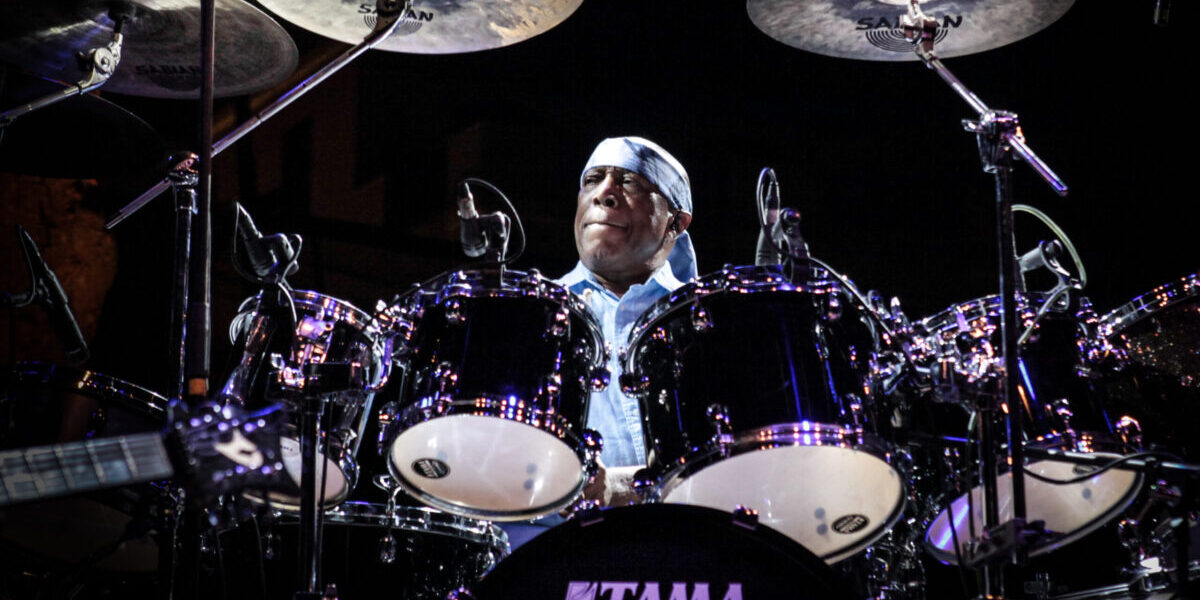
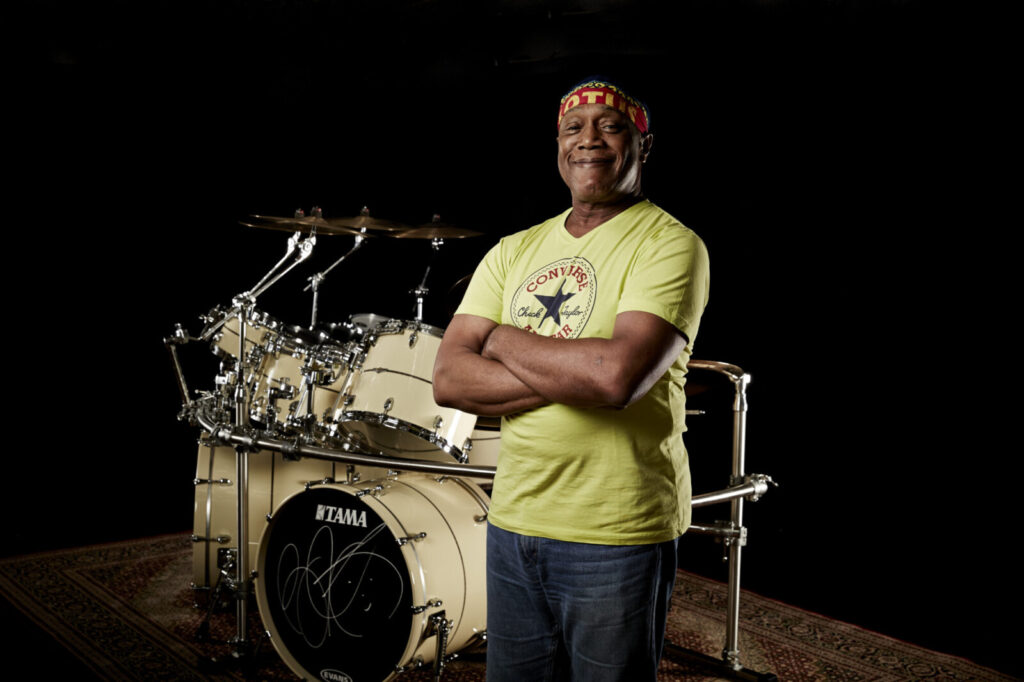
Few drummers need an introduction to Billy Cobham. You’ve heard him, you’ve heard of him, or you’ve heard someone influenced by his playing. An innovator who coaxed volcanic eruptions of toms, kicks and cymbals from rigorous rudimental technique, Cobham has helped redefine the drummer’s role behind the kit and away from it.
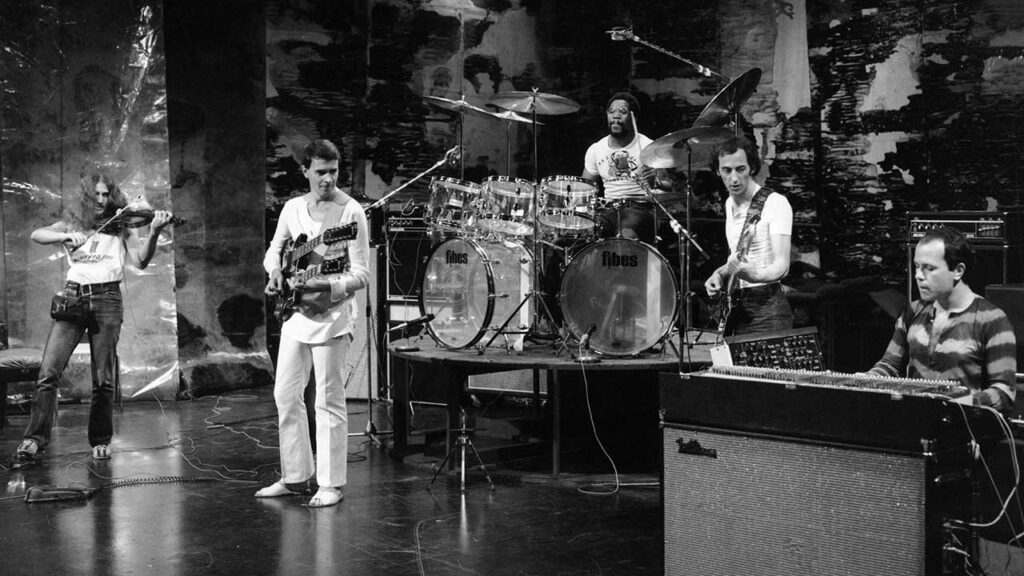
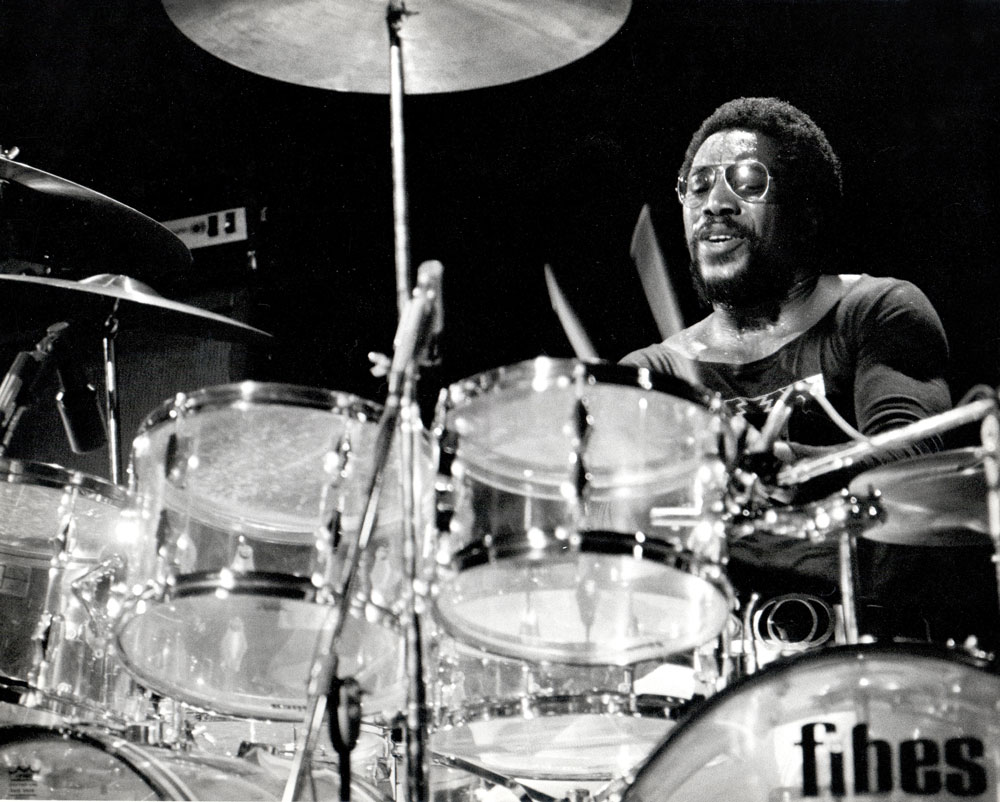
While playing with Mahavishnu Orchestra in the early 1970s, Cobham took double-bass technique to another level, helping birth fusion music in the process. His run of mid-’70s solo albums forged sophisticated jazz forms with ripping funk, establishing him not only as an unrivaled groove machine, but also as a composer and bandleader. He was an early explorer of effects units and electronics, searching for new sounds and textures live and on record, especially in his solo pieces.
Cobham’s music and licks have had long-lasting reach, too. His classic track “Stratus” underpinned a hit for U.K. trip-hoppers Massive Attack (1991’s “Safe From Harm”) and also became a staple of guitar legend Jeff Beck’s live sets. His galloping double-bass intro on “Quadrant 4” inspired Alex Van Halen’s approach to VH’s classic “Hot For Teacher.”
Cobham’s eclectic resume ranges from jazz royalty — Horace Silver, McCoy Tyner, Miles Davis — to singular artists like James Brown, Peter Gabriel and the Grateful Dead. The maestro recently celebrated his 80th birthday and continues to follow his muse in small jazz combos; modern fusion; Latin, world beat and electronic collaborations; and touring/festival ensembles revisiting his repertoire.
This interview, done by phone and email, was originally conducted in 2009 for a profile in Wax Poetics magazine. Much of the discussion, especially the drum-specific bits, fell outside the scope of the magazine’s focus. But there were too many good insights into drums, music and Cobham’s career to leave on the cutting room floor, so it’s been re-purposed here.
Do you remember your first exposure to the drumset? Yes. It was Sonny Payne, playing with Count Basie. I think it was on Ed Sullivan or some musical show. It was the beginning of television. He made that band soar. The band just levitated, this 15-piece big band. All he had was a hi-hat, snare, bass drum, floor tom, one ride and a crash. This cat just did some things that were beyond understanding.
That was your personal Ringo-on-Ed Sullivan moment? Yeah. I felt that Sonny opened a door and gave me purpose. But I had a lot of questions. I was always kind of an observer and would want to analyze. What did that mean? How did he do this? I wasn’t asking anybody else questions, just doing it in my own way.
How did you start playing? My dad had a little working band, doing dances and stuff like that. Sometimes I’d get a shot at playing. Dances in the Panamanian community were a big society affair, and there was always some kind of attraction. Somebody’s kid would come up and play a little bit, a chance for them to show off the family. I got my licks in from time to time.
You went to a high school for music and art? Yes. Until then, it was all about listening and learning, observing, trying to figure out how I wanted to be a musician and a specialist at the drumset. At first I thought I wanted to be a percussionist and play more classically-oriented music, so I chose to study marimba, xylophone, and music theory. But I didn’t feel as much of a kinship with the other instruments as I did with the drumset.
Who were you listening to at the time? Miles, Coltrane, Nat Adderley. I didn’t listen to the drummers as much as I listened to the musicians. I listened to the bands, how they functioned. If the drummer stood out to me, that was a problem. Because drummers aren’t supposed to stand out. It’s not like they’re not supposed to be heard, but rather, the band is supposed to function as a unit, of which the drummer is one part.
Sonny Payne stood out, though. Sonny Payne stood out because he threw his sticks in the air, twirled his sticks while his bass drum foot was still moving and keeping time. There was a visual, circus aspect to his playing. But he lent musical support and played in such a musical fashion while doing all that, and the foundation was so solid that the band could just do anything. They knew he was there.
Louie Bellson was another. He used two bass drums and very complex solos to present his ideas, but when he played behind the Ellington band, or even with the Basie band for a minute, boy did they rock. You didn’t think about Louie and the Basie band as separate things. You just thought: The Basie Band. Or The Ellington Band.
So you were more influenced by the ensembles themselves than the individual drummers? Yes. I loved the way Trane, McCoy, Elvin and Jimmy Garrison functioned together. I loved the way Miles’s band with Trane, Cannonball, Bill Evans, Paul Chambers and Jimmy Cobb functioned in a certain way. They had longevity. The band had a personality. Miles’s band with Hank Mobley had another personality. Same with Wynton Kelly. The band with Tony, Herbie, Ron and Wayne, and even with George Coleman, had another personality.
Anytime someone changed in the band, the personality changed. But it still sustained a certain integrity. So when Jack DeJohnette got in the band, and Chick Corea became piano player, and Dave Holland played bass, it was a different personality. But it was still Miles. All of the parts functioned in a very special way. When you listened to one of Miles’s bands, it was like going to a museum of modern art, looking at Picassos, and asking, “Which period is best?” They’re all valid. They’ve all got merit and weight, and you’re affected in a different way.
Your first gigs out of the Army were with musicians like Horace Silver, Stanley Turrentine, Shirley Scott, Kenny Burrell. Are you mostly playing straight-ahead bop at this point? No. It was a crossover thing. Yeah, we played some straight-ahead, but there was also this groove. Stanley, for example, was not a straight-ahead player. He had this gospel-esque, church-feeling tenor saxophone thing that was just very special. To me, he was an organ group-style saxophone player, the kind of cat you’d hear in an organ trio or quartet with guitar, organ, tenor and drums. A big, fat sound. When he spoke through the saxophone, it was like he was shouting.
I loved working with him because of that. They were going down. There weren’t too many people playing organs then. That kind of gig was limited in popularity. You had Groove Holmes, Don Patterson, maybe two or three other organists on the scene that were very important. Johnny Hammond Smith was another. You had to take that big old [Hammond] B3 down from back behind the bar, load it up and go to the next gig. Not an easy fate. These were people who are forgotten heroes of the business.
And there were tenor players that just fit in, and guitarists like George Benson who fit into situations like that. They had to have a certain personality to make that thing work. Tenor players like Grover Washington came out of that same kind of school. It was a really very special time.
Mahavishnu Orchestra
• • • MILES To MAHAVISHNU
You started working with the Brecker Brothers and John Abercrombie in Dreams, but also worked with Miles on the “A Tribute to Jack Johnson”material around the same time. Then Mahavishnu Orchestra comes into view. This must have been a pretty pivotal period for you. It was. I mostly only recorded with Miles. If I did any live playing with Miles, it would’ve been in the 1980s, actually.
Jack DeJohnette suggested you to replace him on the Miles gig? I was working with [pianist] Junior Mance and Jack was working with Miles downstairs at the Village Gate. And he came up and said ‘I’m leaving Miles. I told him about you. You want to do it?’ And I said, ‘Sure.’ Jack said Miles would probably come up and take a listen, which he did. I saw him in the back during a set and a few days later he gave me a call.
I would’ve loved to go out [on the road] with Miles, but I had commitments to myself and about working with a band that was developing. I was already recording a little bit, just testing out some things in a small home studio with Wayne [Shorter], Joe [Zawinul] and Miroslav Vitous (a combination that would later evolve, sans Cobham, into Weather Report). At the same time, I was also working with Dreams on some ideas. It was a tremendous developmental period for me. I ended up leaving the Miles gig and going with Dreams, and from Dreams ended up in Mahavishnu.
Pretty gutsy move. So the seeds of Mahavishnu were sown during those Miles sessions with John McLaughlin, correct? Yes. I actually met John in England, prior to joining Miles. Coincidentally he just showed up in New York. I didn’t even know he was coming to work with Miles. I saw him in the studio. He told me he had some things he wanted to do and asked if I’d be interested in working with him. Of course I said yes. In those days you didn’t turn down anything. The competition was so acute. You played wherever you could, whenever you could, with whomever you could, just to keep your chops up and expose yourself. You never knew who’d be listening and watching.
So John and I started working on some things. I remember we made a recording with a French poet (Leo Ferre). We were practicing pretty consistently over a two- or three-week period, before even [future Mahavishnu bandmates] Jerry Goodman, Jan Hammer or Rick Laird [joined]. It was just to play, to understand what we could do together.
• • • SOLO SURVIVAL
You’ve said you ventured out solo just from a need to survive and continue working after leaving Mahavishnu, and set to work on your first record, Spectrum. That album is a bonafide classic, a cornerstone of instrumental funk, rock and jazz fusion. Did you have a sense you’d hit a home run in your first at-bat?
A home run? No, no. I knew that was I was awarded, in a backhanded way by being associated with Mahavishnu Orchestra, a popularity that I could never have gained on my own. Mahavishnu worked so much. Colleges, universities. So I thought, ‘What could I do that was different from what [Mahavishnu] presented? That band had a complexity that I didn’t feel a need to duplicate. It had been done.
What Mahavishnu didn’t have, that I felt I owned and contributed, was the groove. And since I was coming from experiences in the studio with people like King Curtis, Chuck Rainey, Gordon Edwards, and Richard Tee, I felt that it would be nice to make the groove — the foundation, the funky part — much more dominant. Then add a taste of the technical, the pyrotechnical side of Mahavishnu. And it worked.
Were you unaware the album was getting airplay? Yeah. I didn’t listen to the radio. I wasn’t expecting it would be on the radio.
“Stratus” is a huge track from that album. How did you come up with that bassline? At the time, I played piano and it was two-finger typing. And that was as good as I could get (sings bassline). And it worked. I was playing the piano a lot, as I wanted to develop my skills on the keyboard. I also believed that understanding music theoretically would make me a better musician at my instrument, so I started to take music theory very seriously.
I found that people are into what makes them feel good. People want to dance. They don’t dance in 7/4 time in the United States. They do that in Bulgaria. So you come up with something where everybody can tap their foot, go ‘Yeah, cool. I can relate to that.’ And if you can grab people with something that they feel comfortable with, you notice that their shoulders go down and they feel real comfortable. All of a sudden they’re just tapping and humming along. Now you just control something on the top and they go ‘Wow, I never heard that before.’ But they still have a sense of security and that’s very important. And that’s how I came up with that piece.
“Stratus” live at Montreux Jazz Festival, 1976, with the Cobham/Duke Band
How do you feel about that label, ‘fusion’? Mahavishnu, Weather Report and much of your early material is generally grouped under that umbrella. I don’t have any problems with labels. They don’t make the music. They’re a way for people to categorize what they hear. Picasso’s got his geometric period, his pink period, his red period. So it’s a label. I don’t need to spend time or energy trying to decide what people want to call what I do.
Your follow-up, Crosswinds, is another record now regarded as a classic with DJs, funk enthusiasts, and beat junkies, with some of those blazing Latin-feel workouts alongside classic grooves like Pleasant Pheasant and the title track. Did you have a specific plan for building on Spectrum? No. At the time that I was just enjoying success from the popularity of Spectrum. I was also extremely naive as to my musical direction in live and recording concepts and was just trying to keep that positive momentum going. All that happened was a complete surprise and akin to a boxing match where the 800-to-1 underdog wins the world championship without a manager, trainer or any real backup support. I was really not prepared for the future. I also muffed a lot of great opportunities that came my way.
In what way? What kind of opportunities? Mostly things like one-on-one relationships with [Atlantic Records] reps. I didn’t know how to effectively work with the record company establishment. I couldn’t establish a worthwhile business rapport with those in a position to make decisions in my favor, such as marketing my product. I didn’t have a manager, which made me very vulnerable with my marketing direction and insecure about my business relationship with WEA (Warner Elektra Atlantic). As a large corporation, I was small potatoes and fell through the cracks by missing opportunities and generally misinterpreting the music business playing field.
I also lacked understanding about music publishing and copyrights. Understanding publishing is very important, followed by an understanding of recording royalties, live performance payments, and all the various offshoots. I was in the dark and lost quite a bit of money due to my ignorance of these things. Even today, I’m not quite comfortable with these elements.
And understand, no one in the business was offering free lessons in Music Business 101. Everything has its price and the two routes to learning have their pitfalls. I lament that if I only knew then what I know now, I might have greatly improved my chances of success.
Sly Stone, Stevie Wonder, Herbie Hancock and the Headhunters were all happening during this period. Did they or anyone else particularly inspire your funkier moments on Spectrum and Crosswinds? I don’t believe these very, very special people were part of a conscious effort on my part to choose a specific musical direction. That being said, I can’t deny that they are, and always will be, a major part of my subconscious stream of thought. They’re major members of the musical cadre, worldwide, and therefore a musical factor in some way in what I do.
Looking back, you recorded two very good first solo records. Did it feel like it at the time? At that time, all I could do was take my best shot and hope that I got over with my musical approach or concepts. I believe that I had the element of surprise on my side and that many in the recording industry were not prepared for me as a front-line artist. Drummers are generally not expected to make hit records without the help of others considered more astute, creative and imaginative.
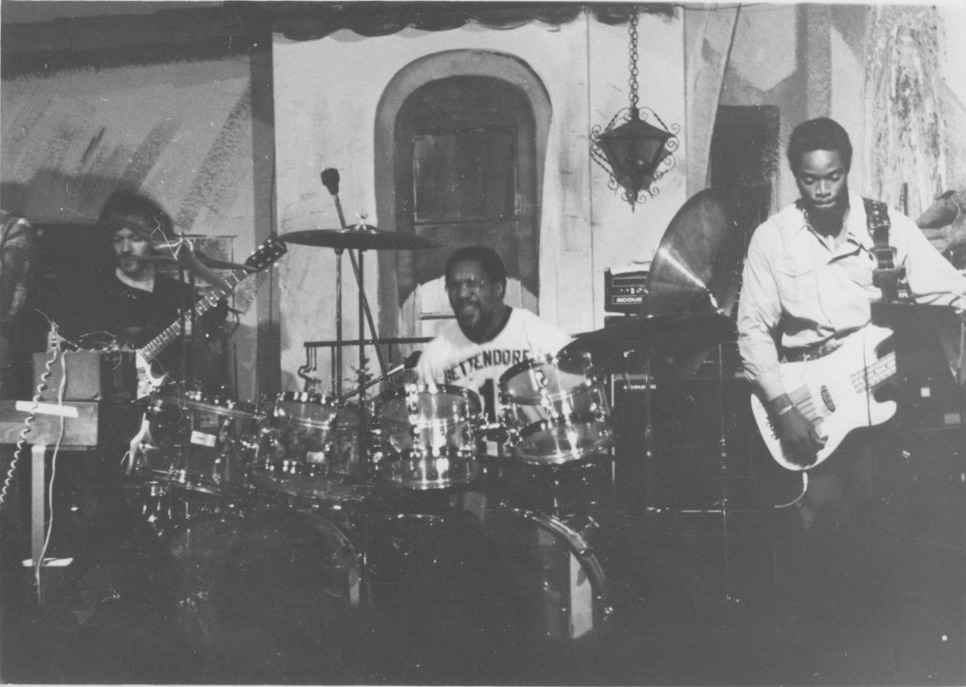
Cobham at the Golden Bear, Huntington Beach, Calif., sometime mid/late ’70s. Photo: Bill Donley
Looking at your discography during this period, it doesn’t look like you were doing many sessions, although you appear on some key material with guys like Larry Coryell and Stanley Clarke, even the Brothers Johnson. Were you pretty much exclusively touring and recording your own bands during this period? I was working wherever and whenever possible.
Were you enjoying being a bandleader? For many years, I didn’t feel like I was enjoying the experience. There seemed to be no time to reflect upon what was going on, fronting a band. I had so much to focus on and never enough time to simply meditate on what was happening, what had happened, and where fate might direct me. I think I started to feel more at home with being a leader, front man, maybe within the last 20 years.
Let me ask you quick about the Cobham/Duke Band. George Duke said you guys had been talking about forming a band for some time, while you were with Mahavishnu and he was with Zappa. The band eventually released the Live In Europe album, but why didn’t we hear more from you guys? I was trying to find a partner with whom I could work and I feel comfortable with both on and off stage. I thought with George I could develop this relationship over time. But the economics, combined with George’s timely success, prohibited me from continuing to work in this musical direction.
On paper it was an all-star combination with guitarist John Scofield and bassist Alphonso Johnson. Was it just destined to be one of those short-lived but classic projects? I believe that it was destined to be a hit or home run for the time we invested. In later years, we would find that the concept, although musically logical and rewarding, would not be so easy to reassemble for one more fling. Even now we try, but the timing is elusive. I would not say never, but the longer we wait, the greater the chance it will not come to be [editor’s note: this interview was conducted before Duke’s death in 2013).
Looking back on your 70’s work, what stands out most to you? You released some iconic funk and mind-bending fusion. I really enjoyed working with Dougie Rauch, George Duke and John Scofield. It was not a long-lasting experience due to Dougie’s unexpected death, but that band did have its moments. I’m only too sorry that we didn’t have more time in each other’s presence, making music. Some recording sessions like ‘White Rabbit’ (George Benson), ‘Sunflower’ (Milt Jackson), ‘Magic’, ‘Simplicity of Expression’, ‘Matterhorn,’ (Louie Bellson), ‘Sky Dive’ (Freddie Hubbard) or ‘Jack Johnson’ (Miles) really make me smile at the memories.
• • • THE EIGHTIES
Into the ’80s, you’re still recording prolifically, what looks like an album or so a year. Then you back off a bit into the mid-’80s. Is this when you started to do more work with guys like Jack Bruce and Bob Weir? Actually around 1978, I began to feel as if music played in the U.S. was no longer attractive to me. Groups like the Village People and others were successful with cover songs of well-known classical pieces like Beethoven’s Fifth, for example. [The Village People’s] In The Navy was a successful pop tune then, and looking back on that scene, I remember it was a deciding factor to take my life to another part of the world (Cobham moved to Switzerland in 1980).
Did you feel creatively spent, as a drummer or composer? Was it a relief to not lead a band for awhile? I felt that I needed to learn more about myself as a person than as an artist. I felt that I could not sincerely play my history. I did not feel in control of what I played because I wasn’t sure where, how, when or why these ideas emanated from within me. The beginning of the 1980s was a period of inward searching for me. I also wanted to better understand why people are so easily duped into accepting a particular dogma, set by a few, as the direction. I decided to take a break from fronting my own band and follow someone else’s for awhile.
Granted, one of the bands I ended up in was based in the U.S. anyway (Bobby and The Midnites), and the other, Jack Bruce and Friends, was managed by a North American agency. But I found that living outside the bubble really helped me develop a broader sense of self, in all aspects of my life. I felt I could bring a more unique approach to playing as a supporter of musicians than if I had stayed in the U.S. and not pursued my interests globally.
Did you envision the move to be as permanent as it has proven? No. I thought I would stay in Europe for about six weeks and then return home to New York. After almost thirty years, it has been a long, extended six weeks.
Do you ever envision a return to the States? No, it doesn’t seem likely. Time has gone by and definitely shaped my life to enjoy the world as my stage. Of which, the USA makes up a portion of no less significant importance than any other country on the world map.
Speaking of that Bob Weir project (Bobby & The Midnites), a collaboration with a member of the Grateful Dead seems bizarre in the context of your career up to that point. Did it seem as strange then as it sounds even now? At first, yes, but after listening to the music that Bob wrote and falling into step with it, I found that the collaboration was well worth the effort to learn the music and develop a strong rapport within the band.
• • • TECHNIQUE
There’s a clip of you playing with Horace Silver in 1968 where you take a solo. You’re playing a small kit, what looks like a standard bop kit, but sitting pretty high, towering over the kit. And I noticed that you’re already riding with the left hand, developing that open-hand lead style. When did you start developing that? I believe that started around 1955. When I was told you could only play the drumset if you were right-handed and you had to use the traditional sticking in order to play, I asked myself “Why is that?” I think I asked one or two teachers and they just said ‘because that’s the way it is.’ I wouldn’t accept that. ‘That’s the way it is’ doesn’t work for me.
So what would happen if I did something different? I don’t like cross-sticking. I don’t like to have to put one stick across the other. What would happen if I lowered the hi-hat stand? What if I played matched grip and put my ride cymbal on the left side next to my hi-hat so that I wouldn’t have to spend so much energy going across my body? Wouldn’t that make more sense? And logic said yes. So I did it.
And you’re doing this at 14, 15 years old? Yeah. Because I’m trying to find the easiest way to play the drumset. For me, this isn’t a sport. I’m just trying to play more musically and effectively for a longer period of time, using the energy I have, without having to pant after every solo or after playing a song. I didn’t know about posture and breathing yet, but it all seemed to lean in that direction.
Had you been playing the kit long enough that you hadn’t yet developed the right-hand hi-hat habit? I had, but then I thought, ‘This is stupid, let’s try something else. I know I can do this and it can’t be that difficult.’ Understand also that, at the time, certain aspects of the drum set, like the hi-hat and bass drum pedals, they weren’t very highly developed. Drummers then weren’t doing what they’re doing now with the hi-hat. They weren’t concerned so much with their ability to play the bass drum, to control the pedal, as they were with just being able to play four on the floor and support the band for as fast and as long as they could.
Generally speaking, drummers weren’t thinking melodically. They were thinking rhythmically. Today, many drummers have moved up to the idea of thinking musically, incorporating dynamics, velocity sensitivity, phrasing, and being more selective in what they play. Then you’ve got speed and dexterity, and all of that is based around the center of power within the body. You’ve got all these things that you have to pull together and coordinate to project your ideas and thoughts. This is new world. So the instrumentation, the equipment that you’re using, has to reflect this.
You’ve said John McLaughlin suggested adding a second bass drum to your set. Had you played much double-bass before that? No. John asked me to add the second bass drum for the new music he was developing. I balked at first because I did not have a clear concept for the additional drum. But as I thought about what to do with in the following days, ideas began to develop. I just needed to understand for myself what the general parameters were as related to the musicians and the music as an end result. Then it wasn’t difficult to move forward.
The double kicks have become a trademark of your setup. Any feelings on the double pedal? I sometimes use a double pedal, more out of convenience than preference. I don’t receive the same satisfaction from the double pedal that I do from two single pedals working two bass drums.
How much did you military experience shape your rudimental approach? The rudimental training started prior to the military [in drum corps], but the military kind of rounded everything out. I also developed a sense of discipline that I could live with.
How conscious are you of that rudimental training when you’re phrasing or blazing around the toms? It’s not just rudimental training. Not all of it. It’s also concept, development. It’s: Where do you play what you know, and when do you play what you know? For me, it’s about timing, what you hear, and how you utilize it to interpret your thoughts. The drums are just an instrument that projects a reflection, sonically, of what you’re thinking.
• • • CONTEMPORARY EXPOSURE
You’ve been sampled by contemporary hip-hop artists and producers like Massive Attack, DJ Shadow and Souls of Mischief. Have you noticed any benefit to the newly-found exposure? Besides the royalties, of course. I can’t assess the exposure these projects have brought me, but I hope the success of the collaborations involving my tunes causes some to go back and see where the ideas of their idols have come. Of course, everything has a price and this I can live with on the royalty end.
What are your personal feelings on sampling? A good thing if used and expanded upon. It’s an art form within itself. I look forward to expanding upon my concepts through this avenue in the not-too-distant future.
Do you follow much hip-hop or electronic music? No. But I don’t dislike it, either. When it’s good, it’s good. That probably means I understood the message within. Being an instrumentalist, the tune and the groove are more important than the lyrics, especially if the message is a sad one from the vocal side.
Thinking back to the ’70s and ’80s, were you aware that guys like John Bonham and Alex Van Halen were fans of your playing? I did not know that John was familiar with my work. I did meet Keith Moon once, in Atlanta. Aside from that experience, I’ve never thought much about my fan base in this way.
Odd question, but did you ever feel any competition with Tony Williams during that period? Both of you were Miles Davis alumni and fusion pioneers. Didn’t you and he once ‘battle’ on stage? Tony Williams invited me to perform with him in Japan in the summer of 1979. The idea was for us to play together, and from what I remember of this project, the first requirement put to me by his manager at the time was to pare down my drum set. Play fewer drums. He said that Tony wanted me to do this. So I went to Tony, in the presence of the manager, and asked ‘What should I remove? Tony said, ‘Leave it all up.’ So I did, and we played a very short piece in collaboration. So much for managers.
Your work seems pretty varied these days. I’ve heard or seen clips of you in small acoustic groups, world beat and Latin projects, jazz combos. Which ways are you consciously moving these days, and what projects are you most excited about? I’m currently in the middle of a four-CD project that reflects what you’ve noted above. I do play within many different musical environments and find the transitions from one to the other easy and seamless. I like the idea of multiple musical presentations, expressing myself comfortably within more than one musical environment at a time, with minimal need for adjustment.
Playing within the realm of the WOMAD projects, performing with Ron Carter and Kenny Barron in a jazz trio, working with [Afro-Cuban ensemble] Asere, Okuta Percussion or my band Culture Mix make me feel very fortunate and transition comfortably from one musical stop to the other. There are quite a few different performance opportunities out there for me and I try to find a way to connect with as many of them as I can.
What do you like to do outside of playing the drums and making music? Photography is a passion, has been for 45 years. It has pulled through some very rough times during those years. My camera has been my partner when there was no portal through which I could find release.